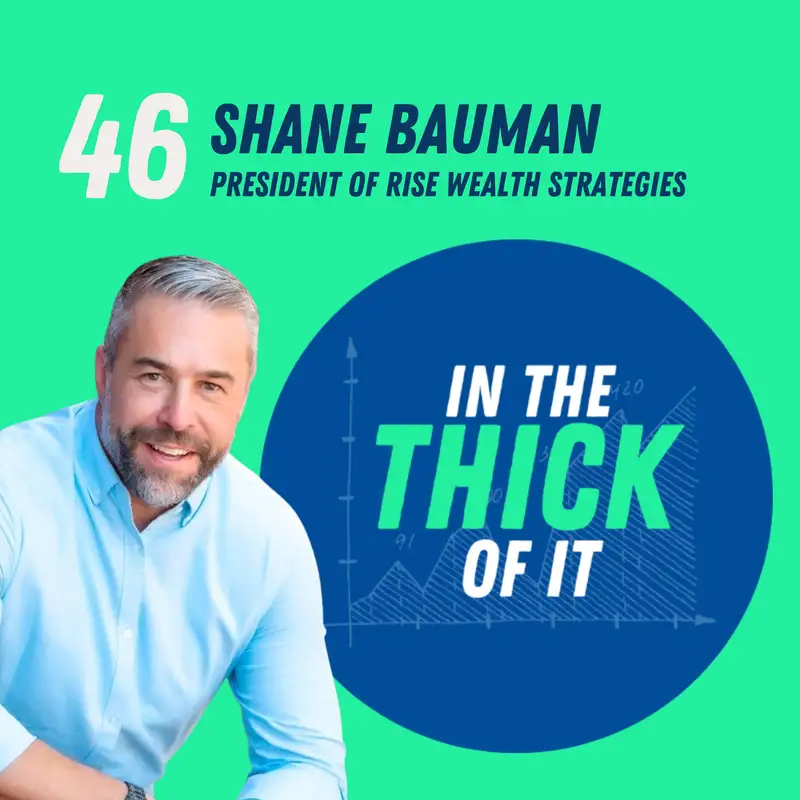
#46: Shane Bauman, President | RISE Wealth Strategies
Download MP3All right.
Well, after
a long, long break, I am thrilled
to be starting In the Thick of It again.
Shane,
thank you so much for joining me today.
Would you maybe just start with,
a quick intro
and, a little bit about your your firm?
Yeah.
Do you want me to tell
about my kind of backstory?
You want to talk about the firm,
but let's talk
just briefly about the firm
and then kind of dig into your backstory.
Okay.
So we started Rise
Wealth Strategies in January of 2019.
We're a comprehensive planning firm.
Planning isn't quite adequate.
We're really more advocates
who come alongside clients, understanding
what's important to them.
And our goal is to get people
to a place where their purpose
and their wealth align.
And we really do that
by organizing and simplifying while
so we love to come alongside people
and help them get where they want to go,
realizing that money is a tool
and when it aligns with their purpose,
then crazy things happen.
I love that.
In fact, I was talking with somebody
earlier today about money itself
is not evil.
The love of money is evil. And money,
just like you said, it is a tool
and you know, when I think about money,
the biggest thing that that money buys
is time and autonomy.
And yeah,
you may make some noise and some fun
vacations, but,
you know, money is an enabler of time.
Yeah. It is.
Yeah. Specifically liquidity.
I mean, I was just talking to a client.
No, actually,
somebody that might come on my podcast,
and I was talking
about the idea of liquidity.
I said, you know,
I think most people think liquidity.
It's like the non sexy cash
that it's there
just in case something really bad happens.
But we actually look at it
quite differently.
Yes, that is important,
but having cash available it just allows
you to make decisions differently.
Like if you are all of a sudden done
with your corporate life
and you want to go start a business
if you’ve got liquidity available,
you can do it, or market cracks
and all of a sudden real estate drops
and you want to buy
a piece of real estate.
If you’ve got cash,
you're in a better position
than people who had everything in the market.
And so, you know, that's very different
than what a lot of my
competitors will talk about.
Market returns are important, obviously,
but having cash allows that freedom.
It's crazy how liquidity and cash
allow freedom, differently
Without the tax consequences of having
to liquidate other assets.
Well that too. Yeah.
Yeah.
For sure.
And it's teaching people
how to become liquid.
I often ask the question,
you know, I'll ask you the question.
Why do you think a 401K works so well?
It's turnkey.
It's easy.
It's money that comes out of my paycheck
before it hits my bank account.
And I've got the tax advantage of,
you know, deferring taxes to
to a future day.
Yeah. It's automated.
The reason it works well is because
people don't think about it,
to your point.
Cash comes out before they spend it.
Why don't we automate our savings
the same way?
So, a large part of what we teach people do
from cash flow management perspective is
how do you automate your savings
so that you you have more?
Because, otherwise, you're making decisions from a position
of weakness when you don't have cash
and you haven't automated that savings
to manage your cash flow differently.
Yeah.
Well, I want to I want to get into
how you got to this point with with Rise.
But let's go back to the beginning
and you're in Colorado,
you're a native Coloradan, I believe.
Yep I am.
What was your growing up like?
So I was born in Greeley, Colorado
on October 17th at midnight
or very close to midnight.
So my parents
actually had the option to decide
if I was going to be born on the 18th
or the 17th.
So on my birth certificate, actually,
my birth certificates incorrect.
It says 11:59 a.m.
and it should be 11:59 p.m.
because it's right before midnight.
Yeah, in my faith
walk it's kind of funny...
It feels like I talk about
God being the 11:59 God.
And I was born at 11:59 so interestingly enough,
that's where I was born.
I grew up, in Greeley
for a short period of time.
My parents moved to Eaton, Colorado,
which is very rural,
tiny little town. I had 69
people in my graduating class.
That was cool.
Growing
up, I grew up in a farming community.
I actually had the benefit
of having two dads.
A biological dad who I love
dearly, who was very much a
9 to 5 guy work at King Soopers
for the Union for a long time.
And, then I had a stepdad
who was a farmer,
and it just seemed kind of comparing
and contrasting my dads
and how they viewed career
versus business.
It was
it was cool, was really cool to see both
and grow up in that environment.
So yeah, I grew up in Eaton,
went to college, CSU
for a couple of years,
and I transferred to UNC,
got my business degree at UNC.
I was a knucklehead
in college. I mean, I just
I grew up in the church.
And at about 18, 19, I decided
I was going to run as far from God
as I possibly could.
And so, started a band,
a couple different bands.
Got into all kinds of debauchery
that I shouldn't have,
and I lived that lifestyle
even into marriage, unfortunately.
But met my wife, around
we met around June of 2001.
We actually went to the same high school,
and she,
was a senior when I was a freshman,
and I always had a had a thing
for her. I was friends with her younger sister
because she was in my, my grade.
And I was always asking her younger
sister, you know, where's your sister?
Where's your sister?
So I was like, why are you asking
where my sister’s at?
I'm like, why do you think I'm asking you?
Come on, put two and two together.
Like I've just yeah, I just,
you know, randomly want to talk to you
about your sister.
And so we ran into each other
at a wedding.
And it's a funny story,
because I'd run into a wedding,
into her at a wedding,
probably a year and a half prior,
and I'd had a little bit
too much to drink.
And I asked her to dance,
and I put my hand on her,
butt and she slapped me and,
so my best friend got married about a year
and a half later,
he's like,
hey, guess who I invited to the wedding?
I'm like, who is like, Jenny? I'm like.
And? He's like, well, you like Jenny?
That's why I invited her. I'm like,
that ship has sailed, dude.
I think I pretty much burned
every opportunity of that.
And so interestingly enough,
we connected at that wedding.
We hit it off.
We had a very short courtship.
We knew
we loved each other pretty early on.
And then, September 11th hit,
we knew we wanted to be married.
We did want to be apart and so,
we got married.
Were pregnant straight out of the gate.
I had a son coming into it. Stepson.
He was six at the time.
We had our first daughter,
Grayson, in early 2002.
A couple of years later, we were decided
we're going to have more kids.
And we had my daughter, Macy Lou.
And, stopped at three.
So, they're now my son is just turned 31
today, actually.
So happy birthday to Kade.
I have a daughter, Grayson, who's 23.
Her husband
actually works with me now as an advisor.
His name's Cam.
And then my youngest, Macy, is 21.
So they're all grown and out of the house.
Yeah.
Going
back to to growing up in the country
and kind of the the two dads
and the perspectives that you got.
Did you work as a kid, like,
were you working on the family farm?
Were you out, you know, milking cows
or work in the fields?
Yeah.
We didn't have dairy cows.
We did have, feed cows.
And those were generally
if I was working on the property
it was because I was in trouble.
But I did,
I did have it modeled for me,
my dad and my stepdad.
Modeled work ethic
for me that was pretty profound.
My dad was, like, early riser,
which I now am too, like, I mean,
he would be up at 3:30/4:00 in the morning
to close out the night before.
And I didn't see him a lot
because he was gone early.
And then, you know, we were latchkey
kids growing up, when I was at my dad's.
So my parents divorced and remarried.
That's why I have the two dads.
And then my stepdad.
I mean,
he worked really hard during the summers
in the spring, but,
you know, the winter, fall and winter,
he got a lot of you got a lot of downtime.
I mean, there's a lot of prep work
and stuff that he did.
But I got to see kind of comparing
and contrasting those, those two dads.
And it was interesting.
So I, I did start working when I was probably about
I was probably 18 or 19.
I would just kind of do
odd jobs here and there.
And I don't feel like
I really embraced work ethic
until college,
because then I was I was working
full time and going to school full time
because I just needed to make money.
It was just kind of in those college years
where I kind of picked up after both
my dad's really found enjoyment in work,
honestly.
You mentioned starting a band.
Were you musical throughout your growing
up, or was that something that came?
Yeah, yeah.
I, my parents put me in piano,
when I was a kid,
and I wish I would have stuck with it,
because I was really
I was good at it.
I could play songs by ear.
I still can to a certain extent.
I played trumpet a bit
when I was in middle school.
That came pretty naturally for
me, and I kind of gave up on,
instruments, actually.
And I just, I always love to sing.
And my stepbrother, at the time
when I was probably about
I was freshman year in college, he,
he had a band and their lead singer
bailed on him, like, right before the gig.
And they were playing all, like,
grunge cover, you know, stuff
like Pearl Jam and stuff like that.
And he's like, hey, what? You good stuff?
Yeah. Good stuff.
He's like,
would you consider stepping in to be,
you know, our frontman and do, you know,
sing for us?
I'm like, well,
there's not a lot of time for me
to make sure I know all these songs, but sure.
So we played our first gig in, The Park in
Eden, and I was scared to death.
Man, I like, had a death grip
on that freaking mic.
And, But I just fell in love with it, man,
and I just.
I took vocal lessons.
He and I were kind of in and out
of a couple different bands together.
I was in a blues
band for a while. We played
kind of hard,
grunge ish classic rock
with kind of a funk twist.
That was our kind of our last band,
but it was.
It was a blast, I miss it.
What were you were you writing
your own music or were you?
Yeah, it was almost all.
It was almost all our own stuff.
So that first band was covers.
And then after that,
I said, dude I want to write our own stuff, like,
let's figure out how to do that.
And, you know, my stepbrother,
insanely talented.
He taught himself
to play guitar, bass and drums.
So he would write all of those parts.
I would write the melodies, the lyrics and,
yeah, man, it was it was fun.
It was fun.
You also mentioned starting school
in Colorado,
and then you said you transferred to UNC.
Yes. In Greeley. Yeah.
Not University of North Carolina. No.
Okay. University of No Credit.
In Greeley.
The bears.
I was thinking, man, that's a
that's a big shift
going on the East Coast.
Now it's kind of funny,
I actually, I, I was a pretty good
football player in high school.
I had,
I had a couple of schools
kind of knock on my door.
And Cornell was actually,
kind of knocking on my door.
That's Ivy League.
So I couldn't have got a sports
scholarship,
but I had, you know, pretty good grades
and head coach,
I mean, he called me directly
one time and I was like, hey, you know,
I've seen your academics.
I think you could probably get you
an academic scholarship.
Would you come check out the schools?
Like, I don't know if I really want to,
and it's kind of one of those mixed bags
or I have like a little bit of regret.
But I also know, like,
my body hurts at 52,
because I did,
you know,
beat it up pretty good
even in the time I was doing it and doing
a bunch of other dumb stuff afterwards.
But it's kind of one of those things where
I could have went to Cornell.
I mean, that's a good school. And I did,
you know, I did and play football.
But yeah, funny how those things pan out.
So. So did you play at CSU or at. No.
I said I had some friends that walked on
and were trying to get me to walk on
with them, and I didn't.
I again kind of regretted that I didn't.
I played flag football and, that was
at least back then,
it was pretty close to full contact.
In college so that that gave me
the rush I needed for full contact.
But yeah, I didn't.
I didn't play after high school.
I had buddies
that did flag intramurals in college,
and there was at least
a couple of torn ACLs.
Oh yeah, you know, major ankle injury.
Oh yeah. Yeah.
So we were we were it was funny
because the team that we had, we were
we were good and we were
we were none of us were in a fraternity.
But we played against
all the fraternities.
We were kind of this mishmash of former
high school athletes, some that,
you know, played like JuCo college.
Some guys were still, like, playing,
we had a guy on the lacrosse team,
a couple guys
who try to walk on the football team.
So we were good, man. It was fun.
So talk
to me a little bit more about college.
What did you study?
You were you were you a good student?
I was a terrible student in college.
I, it's, you know, high school
as I think I was a 3.6
I got, you know, I don't remember what
I got in SATs or ACTs.
I think I did pretty well, in college,
I mean, I just
it was all about the social side of it
for me.
I started out, as an engineer up at CSU.
They've got a really good engineering
program up there, and,
I did that for about a semester, and
I was in the engineering dorm,
and I was like, these are not my people.
Like, I could do this,
but I don't think it's how I'm wired.
Like, I got along with everybody.
I was friends with everybody in the dorms.
But it's like I think I’m too social
to be an engineer.
And so I pivoted to graphic design,
and I
found that I really loved fine arts a lot.
Like, I love sculpture, I love figure
drawing, I loved pencil drawing.
I loved that
more than even graphic design.
I was just fascinated by fine arts,
but I quickly realized I wouldn’t make money.
At that time in graphic design or,
fine arts for sure,
because most of the fine artists, I mean,
all their wealth goes
to the people that are after them,
Michelangelo being, you know,
kind of my favorite artist of all time.
And then I saw I was like,
I got to do something different.
I also didn't, admittedly, like the Greek
system at CSU, which was very prevalent.
I got into some, some altercations,
let's say, while I was up there
with a lot of the Greek system and,
a lot of my friends were in Greeley.
So I went to UNC and decided
to get a business degree with,
with an art minor.
That's a that's a heck of a transition
from engineering to art to business.
And one
of the things that that strikes me,
and when you talk about being a musician
and you talk about the art component,
are you just naturally a creative person,
like,
is that is that something that that stirs
joy in you?
Is that that creativity?
Yeah, it really does.
And it's interesting because like
from a school perspective,
I was always really good at art
and science like art and science.
Just logical. Made sense.
I didn’t have to memorize anything,
which is very concrete.
Yeah.
I just
I had this creative side to like I do.
I love to create things.
It's part of the reason I make businesses
and I'm in a business.
It's highly restrictive.
So put that one together. But,
I do I love to do creative things.
It's it definitely gives me
I haven't found time to do enough of it.
I've been like, talking to my wife.
I'm like, I need to figure out
how to play the guitar
because I have it on my bucket list
to write, write and produce my own album,
before I die.
And I want to do something cool.
So at some point I gotta get serious about
I gotta, I gotta find margin to do it
so I could play a few chords, but like,
I it's it's nothing to write home about.
You mentioned that
you work your way through college,
but what kind of jobs did you have back then?
So let's see.
I think I started at,
at the Buckle, which was retail.
Yeah.
Selling clothes, like nice stuff.
I was terrible at it. Terrible at it.
Like, I just, I was like, man, I'm never,
I am never gonna make it in sales.
Which is so funny
because everything has changed
since I've gotten older, but I was like,
I don't know how people are selling
clothes. Like, it was terrible,
but I loved getting the discount.
But it was just like I was not good at it.
And then when I went to UNC,
I did a stint at a call center.
Actually, I was,
so I went right back into sales,
but I was literally calling people
and convincing them to go, collect money
for, like, the Heart Association,
American Cancer Research like.
And I realized I could actually get
I was pretty good at it.
And so, I did that for a while,
and then there's a pizza
joint in town that I was like,
I know I loved their pizza.
It's called Punch Brothers Pizza.
It's not a brand that's around anymore,
but it was just kind of this really cool,
one off kind of boutique pizza place
where they hand Hand-tossed pizza.
And I went in one day
and a guy was like, tossing pizzas,
and the guy that runs the joint,
I was like, hey, are you hiring?
He's like, yeah. So I started as a driver.
I worked inside
and I became assistant manager.
Then I became a
co manager with another guy.
And that was
kind of, that was the bulk of my college
experience.
Oh, I forgot, I actually loaded trucks
for a while too, and delivered cabinets.
So I did a lot of different
kind of odd jobs and stuff when I was in college.
Yeah.
You, you stayed busy, and it sounds like
you still managed to have a social life.
Oh, yeah.
Probably more of a social life
than I should.
Probably not sleeping a lot.
No, I wasn’t, you know, I was a night owl.
I'd stay up till three in the morning
most days.
And that's complete without.
Now it's flipped.
I get up around 3:30/4:00 in the morning,
go to bed at like, eight.
So full circle.
Yeah, exactly.
I think it's a fair assessment
to say that the, the art classes
were probably really stimulating,
but outside of that,
like what were the
the subjects that you, you really enjoyed?
I always loved marketing.
I actually loved all my science electives,
even though they weren't going to be
anything that I could practically apply.
Any of my math classes I loved, I was
I was really good in accounting,
but I hated it was just so monotonous.
As a matter of fact, when I was in, up at UNC,
I had an accounting professor, and he
his grade was partially contingent
upon attendance,
and my attendance was hellacious.
I get A's on everything,
but I ended up getting a B
because he downgraded me because of my attendance,
which just pissed me off.
I was like, give me a break.
I know what I'm doing.
Like, why, why,
why does it matter if I'm here?
So, yeah, those are the classes
I really liked.
So it was it was kind of
a blend of the creative and the concrete.
Like, I was never good at, like,
geography or history.
They fascinate me, but I just
I didn't have the right mind to
to memorize states
and capitals, dates, people.
And I just,
I love the concepts of it, but it was just
it wasn't something
that I ever really excelled in.
I, I've
told the story a handful of times
and clearly, you know,
even if your grades weren't, weren't
super great,
you know, there's, there's this expression
“it’s not what you know, it’s who you know”,
and a while back, I went to downtown
Dallas for a meeting with a client.
And in the parking lot, there was this
beautiful cherry red Ferrari.
And the license plate said 2.0 GPA.
And I remember thinking,
if that is not the the picture of, it's
not what you know, it's who you know.
Oh, it's so true. That is it.
I was a 2.6.
So I was slightly better than the guy
driving the Ferrari, but there you go.
Well, so post college,
what what were your
what was your early career like?
So it's funny, I came out of college and,
I had this professor, Chuck Washington, who
he was, I loved Chuck.
He was a pretty dry professor.
For some reason, he he remembered me.
He liked me, and he said, hey, I have this
because he was
still a consultant on the side,
but he was also still teaching at UNC.
He said, I have this I have this, company,
and they're looking to hire somebody.
Would you be interested in applying?
And I said, sure.
So it was a it was a distance
learning school in Fort Collins.
I don't know if you remember the days of,
like, Sally, Sally Struthers.
Well, yeah. Yeah, it was
I think that was the.
And I might be,
might be the wrong name, but where they
she would like be on TV talking about you.
You can make $70,000 a year
being a medical claims billing specialist.
So this was a competitor
to that whatever school I,
I don't remember the name of the school
that she was at, but,
I started there and I was actually,
I came on as their with
the intent of eventually being the CEO
of this company, which is so funny.
I came in and I was running all their
production, so I had to learn how,
like, how mail inserter worked
because they did a ton of direct mail.
I had to learn how to,
I can't
remember the name of the machine they used
for producing, like, student materials,
docytech, how to learn
how to how to fix docytech
and supervise people that were running it.
We had a production team that would, like,
assemble all the student packets
and mail them out, because this is like
before the internet really took off.
And, so I did that straight out of college
and, at the time
and I, continued to date a girl
that I knew in college, and she was from
Huntington Beach, California,
and we kind of broke up.
And then, you know, the dumb thing
is, is that this, this distance
learning school sent me to, some,
it was like a conference in Anaheim.
And I told her I was going to be in town.
And so we reconnected.
We really started dating again.
Shortly thereafter,
I moved on into beach, and,
that was fun and miserable
all at the same time.
I was there about nine months.
We ended up, you know, moving in together,
which was an absolute mistake.
I was doing inside sales
for an equipment leasing company.
The closest thing, the
boiler room you can imagine, like,
it was just.
It was just a rough business,
like hard core sales.
It was. It was rough.
I hated it, and, my mom was always like,
hey, if you if you ever want to come home
because you could tell
I wasn't doing good.
She's like, I will, I will come out
and I will get you.
We'll load up a truck
and you can come home.
Because she knew I wasn't doing good.
So she.
She did.
Went back and called back to work for a
western of distance learning school again.
But this time I was in the marketing
department, which was awesome.
I got to be their project manager,
and I learned a ton about marketing there.
These guys were all about the AB tests,
like they would run,
you know,
two mailers side
by side, change a couple of things
and see which one perform better.
Or they do different TV spots,
radio spots, back that
and that was that was cool.
I got a lot of a lot of fun out of that.
So, just for kind of like a time
reference, this is like mid to late 90s.
Yeah.
So this was 97 to about
2000.
Yeah.
And and a
lot is changing in the world at that time.
Oh yeah.
Like we're getting into the dot-com era.
And what was that like
competing in a physical world
while the digital world
is starting to take shape, or was it just
too immature on the digital side of that?
I think it was still so immature
on the digital side.
And we were, you know,
we were cognizant of it.
We knew we could kind of sense
that it was coming,
but I think the company just was
of the mindset that there were still
a lot of rural people
that would still it would still resonate
with them for a very long time.
And they weren't wrong.
yeah, it was something
where they kind of recognized it,
and they were trying
to figure out how to go online.
And I think they did.
After I left, I didn't really stay in
touch with anybody much after I left, but,
I think they did
migrate towards more online learning,
which is now like everywhere.
I mean,
the only really good online learning
in my opinion anymore is you can just
there's so much content to consume
and you can get it anywhere at any time.
So it it man, it's amazing.
I mean, you can go on to YouTube
and learn just about anything.
And if you've got the
if you got the drive and the dedication,
the information is easily
at your fingertips.
And, you know, I think about you
talking about
want to learn guitar and produce your own,
album.
And yeah, you know, not only are there
the tools to learn the stuff,
but the tools that it takes to make stuff
these days have become ways here
easier, accessible
and really, really inexpensive.
And for sure, it's just crazy how much.
Yeah.
I mean, if I go back to the days
when we were in the band,
we had like an old eight
track, like board that we plugged into,
we did we
I wish we had on a recording device,
because most of
the stuff that we came up with
that was super cool.
We couldn't remember like we were
because we
we weren't smart enough to like, plug
in some kind of recording device.
And now it's I mean, it's so easy.
Like, I was, I was looking to pick it up
guitar and I was like, okay,
I can find all these songs
with tablature in my phone.
There's a tuner.
You can actually download
a tuning app on your phone.
They have like use it for music
production apps and software that you can.
It's super easy now.
Like, and you can I mean, you can produce
and release your own album
way easier than you could 20 years ago.
I mean, it's night and day.
It's so it's it's crazy
how things have advanced for sure.
And now you got AI. Like, AI bands.
There's a guy that,
I can't think of his name.
Rick Beato talks about it.
He he plays this I and he's like,
you can't tell
unless you like, really like he plugged it
into this software so he can tell.
You can kind of tell
with like the nuances in the music.
It's not it's it's almost too perfect.
It's not
it doesn't have those imperfections
as much as, like a normal band would.
So it's it's crazy how it has changed.
It's unreal.
Well, so
you you didn't enjoy sales in college, yet
you found yourself doing it
over and over again and post college.
What what happened
next after the learning company?
So from there, my wife and I,
we got married
in, 2001, and I realized I,
I didn't really want to do that anymore.
I tried it, tried to work remotely like this
is before working remote was a thing.
And so I was trying to work remotely.
I just couldn't do it, man.
I couldn't I couldn't focus at home.
And as much as my like
my wife says she loved having me around.
I think she did.
I it just wasn't working for me.
And so,
it's all who you know.
I reached out to a friend of mine
who had been in the mortgage business
for a long period of time
in real estate agents.
I was kind of the early refi
boom days in the early 2000,
the first kind of big revival.
And I said, hey, do you know anybody
that's looking for somebody who's like,
I know a guy that runs a title title
insurance agency in Denver?
He’d love you.
You should meet him.
So I met this guy,
a company called CPR title.
And he was, like, larger than life.
He was, like,
the ultimate sales guy. He was.
And when he was on, he could.
He could sell anything
anybody would buy from them.
When he was off,
he was absolutely terrible.
But when he was on, he was amazing
and he had this huge vision.
He wanted to basically just take over
the entire state of Colorado
with his title company.
And he's, you know,
fighting against behemoths like Land Title
and like some of these guys
that have been around forever.
And, so he kind of had a unique,
slant.
We would close anywhere, anytime,
all 64 counties in the state of Colorado.
And at that time
everybody was closing an office.
So he kind of came in
and disrupted the industry.
So I learned a lot about him,
a lot from him.
What to do, what not to do.
He used to fly
by the seat of his pants
kind of guy, like, he,
he got bad.
There's a point where he was like,
he wasn't showing up.
He would. He would come in the office. He,
like, disappeared.
Nobody knew where he was.
We're trying to run the company
without him.
And, turns out he had a pretty
significant, crack addiction.
And was he.
He actually had two, top RESPA
attorneys on retainer,
but he wasn't listening to them.
And, he,
I met another guy in the midst of this
because I'm like,
I gotta find another place to land
because this thing's going to blow up.
And I met this guy that had other title
companies through my network,
and, he said, yeah,
this guy's about to be investigated
by the division of insurance. He's
going to get shut down.
Well, happened. And he was.
He had criminal charges against him
the whole nine yards.
And so,
I pivoted to this other title company,
helps kind of navigate
an asset purchase agreement
and bring in as many of those employees
as we could into a new,
new brand called Empire title.
And I was in leadership there.
I, had an opportunity to run it,
be an equity partner,
and, quickly realized
that title was not where I wanted to be.
Because you talk about restrictive.
Holy crap.
You can't.
There's, like,
nothing sexy about title at all.
And you're like, you're at the bottom
of the hill in a title company
because the mortgage guys, the realtors,
everybody blames everything.
The technical company for closing goes
sideways.
Even if it's not your fault,
they're going to blame you for that.
And, it's funny, I had actually,
met a guy who was developing,
games for the Xbox
360 through my network,
and I was like, yeah, this is interesting.
And so he, Yeah, he had a relationship
with Marvel Comics, too, at the time.
So this is Marvel pre Iron Man.
Like Marvel,
everybody knew who Marvel was.
But it's not like the Marvel
now like this before
any of the big movies have been released.
And I was like, I need to go.
I need to do this.
I need to help this guy raise money
and see if I can get on with him.
I quickly
realized that I aligned with the guy
who's not dissimilar from the guy
I was working with before, and, he did
legitimately have a marvel comic book.
It was the year they actually released
the Iron Man costume at Comic-Con.
But he had he was embedded
with some really unsavory characters.
Guys, there was a guy that was involved
that was going to,
he was he offered the ability
to collateralize anybody that was,
you know, going to invest in the company
with some oil wells out of Wyoming
after I'd been there a little,
little bit of time, I was raising money.
I raised like a quarter
million dollars a month,
for this company,
mostly family and friends.
Quickly realized the guy that had
the oil wells was being investigated
by the FBI, CIA, the IRS.
Like he he was putting those oil wells out
across collateralize, like, everywhere.
And so I got the hell out of there.
And yeah, it was that that was a rush.
I think.
You know, one of the things I learned in
that season, as I look back is
there was something broken in me
because I was aligning
with these guys that were shady.
And that taught me a lot.
As I move forward about business.
Drill down on that for a minute,
like thinking about these
these two unsavory characters
as you described.
What do you think
you think drives that type
of behavior?
Greed.
I and it's deeper than that, even.
It's, you know, greed. It's power.
You can say whatever.
It's a hole that you can't fill.
There's only one way that you can fill
that hole. And,
for me, that's it's God,
I think it's that for everybody.
Like,
we have a God sized hole inside of us.
And men try and women
try and fill it with something.
Influence, achievement, money,
power, whatever the case may be.
And I think that's what.
That's what drives it.
Like they're trying to fill a hole,
and there's no good way to do it
outside of that.
Outside of God.
Wholeheartedly agree with that.
The mentality of these people.
Do you think that they go about doing
what they're doing with the expectation
that they're not going to get caught?
Oh, for sure. Absolutely.
Yeah.
It's I think they're probably narcissists
as I look back
like they were never wrong.
Both actually super intelligent guys,
tons of failed relationships.
Like it was just they were narcissists.
And so, yeah, I mean, it's, you know,
not to pump my own podcast,
but I just did an episode a few back,
and I talked to a lady.
She's an attorney, in Beverly Hills, actually.
The whole episode was on narcissism,
and it's run rampant in our society.
Like, it's, I think people that maybe
would have never been narcissists
would become narcissists because of the,
electronic culture that we live in now.
That's a really interesting observation.
And even before you said that,
one of the things that was come to mind
for me is my my awareness
of the amount of narcissism
that is out there
has, has grown considerably.
And I've had some people in my life that,
it's become very, very clear that
that they are that way
and it doesn't be on the rise.
And I think you're on to something there
that the, the social media
that, that we live with
and the flashy culture,
that that has to be a big, big driver.
For a large part,
I mean, I've talked about this before,
but I think you look at
who an influencer is generally
they’re people
that are all about themselves,
they’re people that are like,
come into my life
and see what my life is like
and communicates
this false facade.
But it's, I mean, that's
what's celebrated.
That's what I mean.
There are people
that want to be influencers.
And it's like, well, what does that mean?
I mean, I started to go down that path
at one point and I was like,
and I could be an influencer behind.
And I started to kind of question it.
And I'm like, what?
What do I get out of that? Like,
what is that?
What does that really do?
Is that of what I really want to do?
Because to me,
that's a miserable existence.
Having to carry a video camera
around with me everywhere
I go and document my entire life.
I'm just like you.
Well,
and playing off of that like, it's not.
It's not just,
what do you get out of that?
But what comes with it.
Right.
You know, I
when I was young,
I thought it would be cool to be famous.
And as I've gotten older, I'm like,
I have zero.
I have zero desire to be famous.
I want to be unknown, I want to I love,
I love my life, and I love that
I can go to a restaurant with my family
and there's nobody around me.
And I can't imagine that if you have
the spotlight on you like that,
you couldn't go anywhere
without without peace
when you can't even escape it
now, like growing up.
I mean, you could escape.
It's not like everybody had a camera
on their phone back in the day.
Social media wasn't a thing.
But yeah, I mean, like going back to
I mentioned Pearl Jam.
I remember reading about Pearl Jam early
on, and Eddie Vedder hated the fame.
Like he would
he would wear masks in public.
They like, exploded overnight.
He didn't want anybody to know who he was.
And so it's it's interesting
because I think a lot of them
end up being miserable.
It's like, you can't even have
a private life anymore.
You can't have this solitude, because
everywhere you go, somebody wants you.
And if you have an off day
and you're just because
we're all going to have an off day,
I'm going to be an asshole
at some point in my life.
And chances are,
if I'm famous, it's
gonna be caught on camera
and then everyone's going to it's going to
get played over and over and over again.
So like what?
What world do we live in where you're
expected to be on all the time.
Like it just well and to that point
like when you're a public figure,
the public has this expectation
that you belong to them and
that they owe you something and that you
you have this obligation to engage
and that just that just isn't right.
No, it isn’t.
Well, so,
title company raising money for,
a tech startup in the gaming industry.
Yeah. What did your career go from there?
So it's interesting.
I got out of the title company about late ‘07 and went into,
you know, Maxim Games at around ‘08 and,
you know,
right before everything hit the fan,
and so it was hard after that.
I mean, I because I didn't
really have a solid employer
and I separated service from them.
And so I was trying to do anything.
I was trying to recruit, I was
I started a company
to try and raise capital for startups.
I mean, I tried a lot of different things,
and it was miserable, was rough,
very rough season in our lives.
My wife and I had to declare
personal bankruptcy in
‘08
I think it was discharged in ‘09.
That was a really hard season of life
because it just I couldn't get money
to come in the door no matter what.
I tried, so it's super challenging.
And then kind of around ‘08,
kind of late ‘08, I started working
for a marketing company,
a local ad agency in Denver.
I did that for about a year
and a half, and,
one of the things I realized
is I'm not a good employee.
That's probably the one place
where it, like, really drove it
home is I am not a good employee
because I will I will challenge authority
like all day long. And so,
yeah, I was actually, like, praying and
reflecting, not working at this ad agency.
And I literally just laid it down
before God, and I was like, God,
if you want me to stay here
because there's something
I'm supposed to learn,
or I'm supposed to come alongside this guy
and make that known,
but if there's a door that you can open,
please open it.
Because I am not happy here
and we're not getting along.
And it's not.
It's not yielding the fruit I want.
And so it's funny, I'm telling you,
like a week and a half, two weeks later,
I get a call while I'm at the ad agency
from a prospective client who,
he had a paving company
and the paving company, he's like,
hey, this is so-and-so.
I know you guys do work for my competitor.
I was wondering if you can talk to us
about how, you know,
you might be able to represent us
because I see the work you're doing.
It looks like it's doing really well.
So make sure and happens that the owner
was out of town at that point in time.
I'm like, okay, I got to go
meet with this guy to see what's up.
So I sit down and talk to him.
He's super excited.
He's like, hey, we need a website.
We need help with,
you know, collateral, all this stuff.
And I'm like, well,
I think we can help you.
I need to talk to the owner and see,
you know, what we can do.
And so I left that meeting, went back.
Talk to the owner.
He's like, that sounds awesome.
They're cool company.
I can't represent them.
I have a non-compete.
I have an exclusive
with this other paving company.
I was like, So I took a step back,
prayed about it, and I was like,
I'm going to ask him if I can leave and
I can go work and represent that company.
So I did, and he was like,
yeah, that'd be cool.
He's like,
I don't feel like this is working out.
So I started a marketing company called
iMarketing,
in 2009, and
really set it up because I wanted to
I saw the way that
that ad agency was running,
and they created really sexy design.
But I don't feel like
there was a lot of intention
behind the actual marketing plan itself.
And so my intent was to create a company
that we were
we were to do a lot of things.
I was going to use a lot of what
I learned, at the distance learning school
to say, hey, let's do a A/B testing,
like if we're going to do direct mail,
let's test back and forth,
see what works.
And if we're going to do pay per click
advertising on Google,
let's let's run,
you know different campaigns that way.
And you know so I was
I was I launched really with the intent of
doing that to be really
a marketing project manager.
And then I just outsourced everything
to designers and things like that.
I understood what good design looked like
because of my design background
and so, yeah, I did that for
a couple years.
But that's a really important distinction
in how you thought
about the marketing and.
I, I've worked with a lot
of marketing people over the years,
and the ones that I have appreciate
the most are the ones that understand
that marketing is about driving sales.
It's about filling a pipeline.
You know, it's it's not just about,
you know, fun, catchy stuff.
Yeah. Yeah, totally.
If it doesn't make the phone ring right,
if it doesn't lead to conversions
on your website, like, right,
it's it's all fluff and.
Yeah.
And but there again, is this,
this theme of sales
and this thing that you, you didn't love.
And as a business owner,
now you're, you're having to, to go out
and sell the work.
And so at some point, did you,
did you embrace the sales aspect?
Did you
did you come to enjoy it or was it.
I'd say it was once I got into financial
services, like I did it out of necessity.
The marketing company, I did love
the thrill of getting in front of,
a business owner and
saying, hey, let me understand
what you're trying to do and let me see
if I can design something that will help
you get where you want to go.
And in my mind, that's really what sales
is it's like, do you have a need?
Is there something you're
trying to get done?
You're not currently getting it done?
And do I have resources to help
you get there?
And so that was the part I loved.
I didn't I didn't I it was really
when I got into financial services
that I realized that there was like
this paradigm shift that was like,
okay, you're trying to get somewhere,
you don't know how to get there.
And if I can show you how to get there,
then you become my client.
And it's as simple as that.
Like, so that was kind of some of
the reframing that started to happen.
And in those years,
I learned how to do hardcore selling.
Obviously,
when I was in Southern California,
I was calling people,
tell them, you knock door to door,
that's what I call
hardcore closed like sales.
I love consultative selling more. It was.
That's where I found success in titles
where I found success in marketing.
That's where I found success,
you know, as an advisor
is more of that consultative sale.
I did not the hard line
selling like car salesman kind of stuff.
Yeah.
Well, so you, you
had your marketing company
for 2 or 3 years.
Yeah.
So that was
that was an interesting story too.
So I had that for about that, I think it was
about two and a half years, about a year.
And a, a guy I knew he was a mortgage guy
that I knew from title,
he called me because he found out
I had a marketing company,
said, hey, would you come do, marketing?
I'm in a roofing company now.
I'm helping run this roofing company.
I said, sure, so I went and met with them.
They had help with,
you know, brochures and collateral design
website, recall all that stuff.
And so I put together proposal
and, brought it back to me, said, yeah,
he's like, I want to do that.
He goes, because interestingly enough,
I just lost my sales manager.
Would you consider coming in or running
our sales team and our marketing for us?
I said,
sure.
So I went in because they knew I was going
to get paid pretty well to do it.
And I said, you know, we allow me to keep
my some of my other marketing clients.
He's like, yeah, you want to do that?
As long as you can keep doing
what we'll be done here.
That's great.
So I was there for probably a year
and a half
and kind of sad story
of the second generation roofing company.
The guy that brought me in,
unbeknownst to me, was doing some really
underhanded stuff behind the scenes.
Like, there was just
he was paying his family.
He had cars that he was buying.
He was being through the business.
He, I mean, just all kinds of stuff
and ran the company to the ground.
And so that I helped, that owner
navigate personal business, bankruptcy.
And I was kind of on the street.
I was like, oh, what am I going to do now?
I either need to pick up
more marketing clients
or I need to find something else to do.
And that's, when a friend of mine
introduced me to financial services.
So tell me. Tell me more about that.
And financial services
could mean a lot of a lot of things.
So that that first entry
in what what specifically
were you doing in information services?
So I was actually introduced to,
a captive fraternal insurance
company called Modern Women of America.
And I found success.
I had a life and health license.
That's all I had for the first year
and a half.
And so I was basically
slinging their insurance products.
So it's like, if that sounds so terrible,
that's really what it feels like.
You know, getting people
helping them get term insurance
or life insurance, annuities,
they did have a broker dealer
in that area, but it was
at that time I don't know where you know,
where they're at now,
but it was pretty limited
as far as the offering to clients.
But that's where I was there
for about four years and,
won a bunch of their accolades and
their awards for, you know, production.
And I was on track to be in leadership
and didn't really want that.
And, so, yeah, that was kind of my entree.
And I know the name Modern
Woman of America,
but like, are they,
is it a franchise model?
Is it
what were you working in the home office?
No. So their their home office is in Rock
Island, Illinois, the Quad Cities, and,
it's a fraternal insurance company.
So if you've heard of mutual insurance
companies, fraternal,
they're kind of similar, where they are
owned by their policyholders.
But fraternal were created
a long time ago.
They were kind of a spinoff of,
like the Masons and stuff like that.
Like these lore about Lodge system.
In fact, I was asking lots of questions
like, this is so weird, secret society,
like, what's your handshake
I'm going to have to do or something
like, am I gonna have to, like,
give up my firstborn?
It wasn't anything like that, but it was.
They were all kind of created
in that same era.
So, like,
the Knights of Columbus is a fraternal
that some people know about thrive in,
which used to be the Lutheran Brotherhood,
which is the big one
that a lot of people know about.
Those are all fraternal
and paternal are like I said,
they're they're policyholder older owned,
but they also, have to give back
a certain amount of their money
to the community
because of the way
that the fraternal was set up.
So I that was what really drew me to
modern Woodmen was
I loved that
they were doing a ton in the community,
and I liked that
it wasn't a stock health company.
Not that stock
companies are bad necessarily, but I just,
I liked the idea
that they were, member owned
and that they were doing
a lot of community. Yeah.
So you go from insurance to what was next.
So I,
I realized that I wanted to be able
to bring more to the client experience
and have more resources.
So I decided I wanted
and I would consider insurance
and kind of a component
of financial services.
We did do a vestments there as well.
But I wanted to be able to do
as much as possible
to offer to the client
whatever they needed as much as possible.
And a friend of mine who works for a local
nonprofit in Castle Rock
introduced me to, Guardian,
which is another life
insurance company,
but had a much more robust broker dealer.
And really, they had a planning platform
called Living Balance Sheet
that was, you know,
very holistic in its approach for clients.
And so I did that.
And that was
we talk about kind of a dose of reality.
And I would when I was kind of a big fish
in a small pond when I moved to Guardian.
It's quite the opposite.
And I'm like,
I'm sitting in the room
and listening to these people
and how they're like interacting with
clients and the language they're using.
And I'm like, I was like, I was my head
was spinning most days because I'm like,
I know absolutely nothing
after four years of my prior employer.
And so, I quickly learned
how to be a lot more comprehensive
and holistic
in my approach, moved into leadership,
kind of kicking and screaming,
starting to recruit the team.
And then, there was a leadership change
that happened locally.
And one of the guys
that was really instrumental in
bringing me in a Guardian was pushed out.
And I stuck around for about six months
that I decided I need to go somewhere else
because the local leadership, I didn't
I didn't align with them.
I'd recognize enough.
And it's
when I saw a leader that I was like,
oh, I can align with that leader.
I needed to pivot out.
So what?
It seems like,
you know, every step you're building,
you're learning and and where did that
where do that next step lead you?
So I follow that leader over there.
I thought we were going to have
a lot of latitude there
because that was a big deal to me.
Interesting thing
about financial services is
there's a lot of these kind of different
models where you're entrepreneurial,
but you're kind of in a system,
if that makes sense.
And so like,
that's where I was at Woodman.
That's where I was a guardian.
And then this friend of mine
went to MassMutual and he said, hey,
you're gonna have even more resources now.
I have a lot of latitude.
We've been tasked with trying to,
you know,
bring on a lot more inexperienced
advisors, do a lot of training program.
Like it sounded exciting.
And so I went over there.
I did that for about a year and a half.
Was very not that dissimilar
from what I had just left, unfortunately.
And again, I realized
that I have a problem with its authority.
And, and in that situation, it was
maybe it was less about me
having a problem with authority
and more about me asking tough questions
that people didn't want to answer.
And because I'm like, it's
kind of like this mindset of, well,
why do we do it this way?
Because it's the way we've always done it.
Like you hear people talk about that.
I was in that environment. I'm like,
I can't stay here.
I mean, if this is if this is the way
it is, like, that's the answer.
And you want me to recruit,
what am I recruiting to?
We're just like everybody else. So,
yeah, I was along for that role,
so. Yeah.
And so what was the spark
that made you say, okay,
if it's time for me to go off on my own,
I actually had a dream about it.
So, interestingly enough,
I'm happy to share the dream.
It was,
I was just kind of standing down, like,
you know, and like, Subway's
how they have this.
The tracks are lower,
and then you have,
like two elevated platforms,
and usually there's
like an elevated platform in the middle.
I was on one of the tracks
and I climbed up out of the,
where that track was on the ladder,
and I was standing in the center area
and there was an old man
walking towards me,
and he had this kind of young protege
next to him,
and he had like one of those cards
that you like that you like hand out male.
Right?
Like so like the mail guys
and like in like a corporate
setting that's,
you know, that's how they do it.
And he comes walking up to me
and he pulls an envelope out
and he tries to hand it to me.
He goes,
this is yours.
Take it. And it was a check. And I said,
what is this?
He goes to check, just take it.
Don't don't make any waves.
It's just it's guaranteed money. Take it.
And I kind of looked up at the track
and I was like,
I don't think I want to take that check.
He goes, don't make waves, man.
Just take the check.
And I woke up
and I knew I didn't
want to take the check.
I knew that
I had to have more creative input.
I guarantee
you need to not be important to me,
because I had a level of guarantee
when I was at MassMutual and I needed to
not be as important to me anymore.
And so that's
when I really started to reflect on, okay,
what does this look like?
Because honestly,
I almost got out of the industry
because I was like, this is I'm
not interested in this industry
feels like everybody's product pushing.
It feels like they're just trying
to collect their fee, their commission.
People fail out like 1 in 10 advisors
make it in the first three years.
And they expected me to hire
keep ten a year, which
based on their ratios would be higher, 100
to keep ten, which is miserable.
I almost got out and I
was praying about it, and I felt like God
said, do you want to get out
or do you want to do something about it?
And so I knew the answer to that question.
I was like, well, I'm not going
to turn away from a challenge like,
and so I was like, okay, well, again,
I asked for an open door.
I'm like, okay, well,
then I need a way out
because I don't
I don't know what to do. And,
I got a call, one day on my way home
from a recruiter, which happens a lot
when you're in this industry.
And, you know, this guy was like, hey,
you know, we're looking for
somebody who wants to kind of
have their own thing, run their own show,
blah, blah, blah, blah, blah.
And, you know, it's it's whatever.
And for what I was just I was blind.
I didn't
I didn't like, think anything about it.
I was like, yeah, I don't
I don't know that I'm really interested
blah blah blah a lot.
So I call my wife right after that.
She knew where I was in the season,
like we we talked about.
She's very well aware
of what's going on in my world because
she's totally my partner and all of that.
And, she's like, what do you do?
And call him back?
You've been asking for an open door.
Call him.
So I call him
back and I tell him
kind of this jaded mindset
I had and some crazy ideas
that I had to try to disrupt the industry.
And it was with one America,
which is another insurance company
out of Indianapolis, and they said, hey,
we want to we want it back.
You want to give you resources
to start your own company.
And so that's why I decided
to launch Fry's in January 2019.
So that's interesting
that they were recruiting
for someone to go stand up their own shop.
Was this like, hey,
we're, we're we're financial investors
and we're looking for some people
to place some bets on to go stand
something I'm not as much investors.
They they would basically offer
a line of credit.
So kind of yeah.
Yeah.
They were actually because they'd offer
a line of credit
for you to get off the ground.
They had a very lucrative contract,
so they were sharing a ton of revenue
on their insurance, securities, products
for somebody that wanted to get something
off the ground.
What's so funny about that is I said,
well, they're like, would you come out
to Indianapolis and meet us?
And, you know, we want to meet here.
We want you to see
one of our branches up in Chicago.
I said, yeah, and my wife come with me,
and they're like, are you serious?
I'm like, yeah, oh, my wife to be around.
And she sat in on every meeting
I read, which was great.
So, yeah.
Talk a little bit more about that,
that conversation with with your wife.
I've, I've got my own conversation
that I had with my wife
about wanting to start my own thing
and, and the,
the range of responses that I get talking
to entrepreneurs about this.
It's all over the board.
So I unpack that a little bit more from.
Yeah, I was I will say
early on as I started as an advisor,
she saw the latitude I had, like
I was coaching my kids basketball teams.
I was I was able to go to all the games,
I was able to be present.
But the fluctuation in income made
her crazy.
Like, she was like, why, you could
probably be running a company somewhere.
You could probably figure out
to be an engineer.
Or I'm like,
But I'm just not wired that way.
I'm just not like,
I will lose all of this attitude I have.
I there's limited upside.
I would die inside if I had just like
just championed somebody else's vision.
I'm just like, I don't I want to do it.
So she over
the years learned to just embrace it.
She didn't like it because I think
many women want security and stability.
She just realized that's that's who I am.
That's that's what she married.
And, you know, for better or for worse,
that's it.
She married.
And so, in this particular situation,
she knew that she
she knows that my faith is paramount.
She knows that I'm trying to see wisdom
and do what I feel called to do.
And I'm not just haphazardly
making decisions like it's.
I'm seeking counsel.
And I'm also asking God, like,
where do you think I should be going?
And so for her, that's that's
all she needed to know was that
I was like, I was engaging my faith
to say, okay, God, where are you in this?
What do you want me to do?
And so, for her that,
over the years that has changed
everything in that conversation?
Well,
one of the consistent threads with,
with every entrepreneur I've talked to
has been that they have a very,
very supportive spouse and I just
I don't think that you can last long
in the entrepreneurial world.
If you don't have a spouse, you're
you will last
and your marriage will last or vice
versa, right?
Yeah. Yeah. Right.
So with with getting rise off the ground,
was this kind of a like a franchise
model, like, was this like a hey,
you know, we've got your infrastructure
your your plug and play.
You know, find an office and
and you know for the switch.
Yeah I would I
it was a quasi franchise model
I would say it was
they had some systems in place.
They had some resources.
Not a ton of structure.
Much of it I had to figure out on my own.
It was mostly,
hey, we'll share a lot of the revenue
from the sale of these
these products and these tools
with you more than maybe
a lot of other places as well.
But you're responsible for your own it,
which
you get to choose.
You're responsible for your own CRM.
You're responsible
for your own planning platform.
If you want a location, you know,
we're we're giving you a line of credit.
And we're also sharing
all this revenue with you.
If you want to find your own location,
you want to create your own brand,
you can do that.
So it was,
I would say, not really franchising.
Oh, it was just more.
I don't even know. It's our industry.
Weird like that.
I mean, there's this kind of these weird,
nuanced companies that will kind of
create a scenario where you could do that,
but it's not necessarily a franchise.
Here's a few Lego bricks.
Go figure out
which other ones you want to pay for, and
and figure out how to assemble.
Exactly. Yeah.
Some structure, stem cell resources.
But, you know, by and large,
I was figuring it out on my own when,
when I had my last day at my,
my previous firm
that I left to start my company.
I remember coming home early on a Friday
and she's like, all right,
you know,
what are you going to do on Monday?
So what were those first
few days and weeks like for you getting?
Well, to early on
I was under threat of lawsuit.
So it was very stressful.
And I was all alone.
And in our industry,
especially in the positions that I held,
non-compete and non solicits, they can
they're really hard to enforce,
but they can make your life hell and make
you spend a lot of money on legal bills.
And so, early on, it was still scary.
It was tenuous.
It was
I was trying to figure out
which way it was,
because my head was spinning from the,
you know,
threat of lawsuit, because I'd never had
that kind of hanging over my head.
So it was challenging, man.
Like it was.
I would go in
and I had kind of some structure around
how I would manage my day.
And I had a business plan
that I put together,
a marketing plan that I put together.
But I was largely distracted by by this,
you know,
threat of suit straight out of the gate.
How how did that end up resolving?
Jeez.
Crazy.
I, I connected with,
a labor law attorney
because there was there was
it was a dispute on,
what I'd been paid and what I supposedly
owed upon my departure.
And, you know, without giving away
too much detail, just.
There was there was a situation
where the way I was being paid
and the way that I was categorized
W-2 versus 1099 was different,
which is a problem
from a Dol, an IRS perspective.
So that's
pretty much what made it go away.
Well it worked.
Yeah.
It it it did.
Yeah.
And and I so
that for years was also really hard man.
I got to a point
where I was making good income, but I was
I was kind of
I got to the as I was getting towards
kind of the four year mark,
I was realizing how miserable
I was because I was pulled
in so many different directions.
Like, I had,
you know, this expectation
to build a firm and recruit and run
sales meetings
and take care of the bookkeeping
and manage the marketing and support
the advisors and have enough revenue
to share with my leadership.
And like it was, it was miserable.
And I realized that I can do
the operational side of the business,
but I don't enjoy it. I'm a builder.
I love to build.
I want to sell out the market.
Those are the things I love to do.
And yeah.
So thankfully I found somebody that
I could align with and keep the rise brand
around.
I was late 22.
That had a lot of operation
infrastructure that I needed.
It had a planning
platform, had the tech package,
and would still allow me
to keep my brand and champion vision.
And so that's what I've been doing
for the last three years. I think.
I think it's important to recognize what
we're good at, what we're not good at.
Early on, you have to do everything.
But you see, it's
like just sucking the life out of you.
You got to figure out path.
I think
one of the one of the hardest things
I think about running a business
is figuring out what to say yes to.
And yeah, for sure, say no to how?
How does that resonate for you?
And and what were the things that you got
good at saying no to so that you can say
yes to the right things?
The. That's a good question.
So I have to ask myself the question is
just because I can do it
where it might seem like a good idea,
should I do it?
And if if the answer is,
oh, well, you know, I can do this
and follow the law,
but it's actually not in alignment with
the vision of where we want to go
that I have to go.
Why am I doing that?
And it's it's been
I have to say
I like to see has to be like me.
I've had to find people pleasing. Really.
And having this savior complex,
which is very exhausting.
As I've gotten more mature,
I'm realizing I can't.
I can't save everybody.
I need people to learn
how to figure out their own stuff.
And so a large part
of what I had to say no to was
that was fixing everybody's problem.
Instead of pointing them
to or aligning them with a resource
to fix their own problem because
I'm robbing them of something
that they say
they want to be an entrepreneur,
and I'm doing all the work for them.
Was that a was that a moment
that that shifted, or was that a process?
It's been a process.
I'd say it's really been
I've really gotten hyper
focused on that in the last,
like year and a half.
And this bleeds into my personal life,
by the way.
Like I found myself trying to fix
and save everybody and including people
in my family and,
it's exhausting.
And I'm like I said, I'm robbing
people of a learning
opportunity,
a growth opportunity when I do that.
And what's hard about it
is when you start to set those boundaries.
Actually read a book called boundaries
about this.
People get upset
because they're used to you being
the savior guy, the fixer guy. And,
I've had to learn
to be okay with people getting upset.
Like I've grown increasingly comfortable
and fine with people getting upset.
In fact, oftentimes
when I'm upsetting people, I'm probably
doing them a favor by saying no,
asking them a tough question, whatever.
So so
obviously the legal situation was
is a pretty big challenge.
What have been
some of the other challenges
that that you guys have had faced
over the years?
Cash flow
fluctuation and cash flow is a big one,
and it's an obvious one.
Probably the most, most business owners,
knowing what
to see us do from a spending perspective,
like when you get in a business,
you get hit by every sales person
possible,
whether it's internet connection, scanner
or copier.
It's a marketing person,
it's a LinkedIn expert.
It's like your bookkeeping person,
like everybody's
convincing you
why you need them to run your business.
And oh my gosh, you have to do it.
So that's one of the most
challenging things, is managing
the noise in the chaos,
especially now in the world we live in.
Like I get hit all day long with garbage,
email people
trying to sell me stuff,
and that's for me.
One of the biggest challenges
and I've just been the challenge.
I'm right there with you.
And I have a love hate relationship
with LinkedIn and
I these days, I
find myself more in the hate camp
than the love job, and I have neglected my
my LinkedIn for the last several weeks
because I probably got,
I don't know, 50 or 60 pending requests,
and I know that 99% of them or somebody
wanting to sell me something immediately,
immediately. And,
I've gotten a lot better
about rejecting a lot of requests
and I know even with the majority of ones
that I accept, within seconds
I'm going to have an email of, hey,
can we set up a meeting to talk about it?
Just like I just I don't need the noise.
And and I think that with AI,
this is only getting worse
because the speed
at which you can create content
and the tools that are available today
to to get into people's inbox,
to get into people's LinkedIn like it is,
the barriers are so small now
and that the amount of noise
is just that much greater.
And it'll be interesting.
Maybe, maybe there's going to be,
an AI add on for LinkedIn to help you,
like, yeah, clear it out, clear it out.
And, and,
you know, sit back through the, the crap.
But, yeah, I actually had a guy,
wish me a happy birthday.
I can't tell you how many people wish me
happy birthday.
That I don't even know.
And so, you know, again, the guy,
the people
pleaser in me wants to acknowledge
that somebody said happy birthday to me.
Which LinkedIn makes it pretty easy.
Like they've got like for
like canned responses you can send back.
Well, I sent one to this guy
and he's like pleasure, blah blah blah.
And he immediately launches
into a pitch on my birthday.
How disingenuous is that?
So you you send me
a happy birthday request
because you were fishing for business
like that's.
I immediately just unfollowed and blocked
and thing I'm like, this is ridiculous.
I can't even like gross.
And he has a lot of followers who like
25,000 followers are like, wow, dude.
Yeah, well, the truth is, it's
probably a bot that is sending there.
Or he's got an army of of in terms
that are, that are sending
so I mean,
talking about the, the, the peaks, like,
you know,
there's been a lot of lot of junk,
but like, what have been those moments
that have been like,
oh man, this is this is just great.
Yeah, I'd say we're we're in one right
now, man.
We're it's,
I was just talking to one of the visors
on my team where today I was like,
you know,
I am so less interested in the quotas
than I've ever been.
And there's something freeing about that
where I'm just
working my tail off
because I enjoy it and having fun.
And doors are just opening
without much effort.
And I would say
do a large part of my career.
I it's hard for me to find the balance,
honestly, because I've, I just
because I have such a disruptive spirit
in me like I, I don't want to be critical,
but I see where things need to be fixed
like all the time.
And so I am.
I'd say I'm in that season right now
where are not not where I need
to fix everything,
but where I'm like, I'm content,
I'm having fun, I'm I'm happy.
And doors are just opening up actually,
like, easily without much effort.
And so, you know, we're growing
and it's it's fun.
Like the podcast is doing well
without any effort.
People are being introduced me
to become advisors.
Clients are being introduced to me,
getting great feedback from our clients.
It gets we're having fun again.
And we've been really intentional around
how to convey that in our marketing more
and to be more authentic
about our marketing.
And I'd say this is
quickly becoming
one of the better seasons of my career.
Because I'm just just having fun.
And I know I'm just placing less relevance
on things that I used to like.
It's not everything's delivered
I situation.
I think I've treated much of my career
like that.
Is it
hard for you to enjoy those good times?
Yeah.
I have to force myself to
because I am so performance driven.
I've had to.
I actually have a daily plan on a piece
of paper that I put in front of me.
One of the first things I do is
I put the three things that I'm
proud of from the prior day.
Just to kind of reframe my thinking.
And I've just started to do
a lot more of that on my way home.
I'm just going, okay, what went good
today?
Instead? Me
focus on the things that I need to fix.
I'm going to do that
no matter what, so I don't need to.
I don't need to focus more on
the things I need to fix.
I want to focus on the things that I enjoy
today. And,
all of a sudden that becomes contagious
and people notice
it and people are drawn to it,
and it's better, but it's a it's a muscle.
I'm learning to use that
I haven't used before.
I love that
and just thinking about muscle memory.
And you build that muscle memory
and it sticks and it just becomes natural.
And you know, there's a expression
that, you know, if you say something
long enough and loud enough,
eventually people will believe it.
And I think that the context
in which that gets used a lot
is, is not typically for,
for positive things,
but the same is true for positive things.
And and if you develop that muscle memory
and you are able to really focus on
the positive, it eventually
becomes a habit. And,
you know, so often we talk about habits
in the negative, but you know,
that that mentality is a
is a very, very positive habit.
And I've heard other people say like,
force yourself to smile.
Like just force yourself to smile.
And and if you do that long enough,
like it actually stirs something in you.
And and when you smile,
think about how other people interact
with you when, when you're in that state.
And it just kind of becomes this flywheel.
Yeah, definitely
all of that.
Well, looking back, what
what would you do?
What would you do different if you were,
you know, rewind 6 or 7 years ago,
you're starting this all over again
knowing what you know now.
What would you do differently?
I say, I
don't think I would do anything different.
I think I need to
that's the path I need to be on
because of the way I learn.
So some of the best,
best lessons in life
are the most painful ones.
And they you I mean, I,
I believe that you can't grow
without pain.
So like I don't
some of it was admittedly self-induced,
but like
I have a few regrets in life for sure.
But like, I just
I also live life like
as much as I can live life,
you know what I mean?
Like, although I went down
some dark paths like I was
just experimenting and trying stuff
and I just think that's the way I'm wired.
I don't know that I could.
And I think, I think
if I could change anything,
I would change the way
I've treated people over the years
and I would change.
I would have a conversation with myself
to be like, slow down,
focus on the relationship
more than the task list,
because that's what really matters.
The task list will come and go.
Most of it doesn't matter.
Nobody's going to remember
whether or not you did it when you died.
Like, just focus on the relationships
and be present with people.
And yeah, if I could change,
I would say so
there, that would be what I would change.
I would be I would focus on
being more present, more empathetic,
more focused on the relationship
and candidly, the serving people.
Because the more I've done that, the more
joy I get out and just serving people,
in a healthy way.
You know, I, I think about my
best days at work
throughout my entire career.
And for me,
the best days are the days where I am
fully using my God given gifts
to the benefit of others.
And and that just that brings me so much
joy when I'm operating in that sweet spot.
And it sounds like
you've had a similar experience.
Yeah. Yeah, definitely.
Yeah,
yeah,
it's just and embracing and being present.
I too far too often I'm off somewhere else
in my brain and I think it's,
I think it's genetic because I remember,
like, growing up as a kid,
I would be trying to get my dad's
attention, got home from work.
He would just be fried.
And his mind, he was like, he's
literally somewhere else.
His body was there,
but he was somewhere else. And,
just being
present and and just enjoying the moment
and figuring out how you can use this
God given gifts.
It's just we weren't fulfilling.
Hungry? Yeah.
Talking about this,
this idea of being present, I,
I actually had this conversation
earlier today with somebody.
I'm not big on New Year's resolutions
because I'm not very good at keeping them.
Right.
But I think in 2018 or 2019,
I went into the year
with the resolution
that I want to be more present.
And the way you were describing
your dad and, you know,
I see you, you're physically here,
but you're not here mentally.
You're not here emotionally.
And I can't tell you
how many times I get to the dinner table.
And my wife would be like, hello?
Hello, are you here? Yeah.
And so tactically, for me,
one of the things that was really,
really helpful in trying to, to create
that presence was
I turned off my notifications for slack
and for email on my phone.
And so, you know, I would be constantly
getting pinged at the dinner table
and throughout the evening.
And I cannot tell you what a helpful shift
that was.
Just turning that off.
No, it's still there,
but I have to actually look at it.
It's not it's not flying in my face. Yep.
Were there any tactical things that
you did to help improve your presence?
Well, so one of the things that's been
a blessing is I my drive is 45 minutes,
but I'm in very I'm
in a rural part of kind of September.
Believe it.
Believe it or not,
there still are rural parts of South
Long.
Yeah, exactly.
Well, we're on 40 acres, and I don't
I don't change in that. So,
that has been super helpful
because I can decompress
with the podcast and, and pray
I can listen music,
I can do whatever, which helps.
Like, both ways, actually.
Because, like, as I'm going to the office,
I kind of just ease
into my day, when I'm going home,
I can kind of ease out of my day.
But the other thing I'm doing similar
to you is I'll put my phone when I.
When I come home,
I kind of have I'm such a routine guy.
Like, I, I put everything down kind of
about the same pattern as I come home
at the dogs, play them for a little bit,
like go in my bedroom, change,
put my phone on the bathroom counter
and leave it there.
Like my wife is always asking me like,
hey, can you do lunch on this day?
Or what do you
what or what's going on here?
And and I'm like,
I don't know, my phone's not with me
intentionally, like it's in the bathroom.
And that's helped tremendously because
holy crap, that's
that's the biggest culprit.
Making me not be present. My downfall.
Yeah,
I think that's true for for most of us.
Looking looking back at that growing up,
you know, when dad ran a farm
and that that very much
as a business,
was there anything that you learned
from that outside of the work ethic
which you touched on,
but was there anything you learned from
that that has followed you
throughout your career and today?
Running your company?
Yeah, man. High risk, high reward.
I mean, and there's not a riskier
profession, in my opinion.
And being a farmer, I mean, like
you are completely reliant on weather.
I mean, you could
you could do you you could irrigate,
but you also get hit with hail
or a tornado or,
you know, all kinds of other things.
And it's interesting.
My, my, my grandpa was a melon farmer
down in Rocky Ford as well. So,
I was I was surrounded by that.
But it's high risk, high reward. And,
and I want to have control over
my calendar like you do.
And, I say that.
And in the 14 years that I had,
you know, I've been in financial services
that I had, that's always been the case.
But I've come back to that point, like,
I have control over my calendar,
and it's a nice thing. And,
I think we need to remember that
as a society, you do have control over
your calendar.
You do have choices, like I think we tell
ourselves, oh, I don't have no choice.
I have to do I have to do this.
But you always, always have a choice.
You may not like your options,
but you always have a choice.
That that is incredibly well said.
When you also use the word a minute ago.
Regret.
When I look back on my life,
I have a very few regrets.
Thankfully, and most, if not all of them
are about things that I didn't.
For you, do you have regrets about things
that you have done
or things that you didn't do?
It's interesting because it's
as I think about like two
that kind of stand out from regret.
Others, three
that stand out from regret standpoint.
I regret not continuing
on the musical path,
but for me, it was kind of like
it was out of necessity
because there was a lifestyle
associated with it
that I was trying to separate myself
from, and
I wish I would have stayed involved in it
because I really
enjoy the heck out of it.
For me, life is just a rush.
Same thing with the football thing.
Like, it's it's kind of, again,
a double edged sword.
Like, I regret not playing,
not going Ivy League yet.
I also know that,
like, it's probably in some ways
better that I didn't.
And the last one is, I wish I would have.
I wanted to go to Europe most college,
and I wish I would have done that.
I wanted to just backpack around Europe.
I wanted to go see all the stuff
that Michelangelo did when I was young
and didn't have a care in the world
and could have stayed at hostels,
you know, didn't have a responsibility.
I wish I would have done that.
Yeah,
yeah.
And I guess I do have one other regret.
The other regret is I wish that,
I wish I
would have grown up faster
when I got married
because my wife put up a lot of crap
for the first seven years of our marriage,
because I did not grow
up, did not take my responsibility
as a dad and as a husband
seriously and continue to live
a very similar lifestyle
that what I did when she met me.
So those are the big ones.
Think about your kids and you know how
how does that how does that translate to
how you've raised your family?
Well, I'm very forthright
with my kids about the mistakes I made.
I think some parents hide it,
but I've I've talked openly about,
the lifestyle that I've lived in college
and even coming into the marriage and,
It's interesting
because they learned that they took it in.
They didn't they didn't go down the same
path as I did.
They've all, like, chosen
a different path, which has been cool,
and they've seen me grow and change
in my faith and how that's gotten deeper
and that's impacted.
So it's like they came through
that tough season, too.
For the first seven years. They they saw
what was that.
And they saw a couple of them
don't really remember it.
The older one definitely does.
But yeah.
Back to the business.
What are the
what are the parts of the job
that you enjoy the most today?
And what are the parts
that you enjoy the least?
Man, I enjoy the heck out of new ideas
for sure.
Like, I would love to come up with things
that are different.
It's not really hard
to do in our industry,
which is awesome and really kind of
blends into the background.
I really enjoy coming up with new ideas.
I love to build,
I love to work on complicated,
transactions and cases with clients.
I love to see,
advisors when things click,
clients
when things click and they're like,
oh my gosh,
I never thought about that before. Or
we would have never been able to do this
had we not been working with you guys.
Those are the things I love.
I mean, it's
just to see, you know, people excited.
That's I love that when I can see
somebody excited and something changed.
And, I love that.
What, what I don't like still is
we have to deal with compliance
and paperwork and stuff.
It's just.
That's hard for a guy like me
the way that I'm wired.
And there's a lot of inefficiencies
in our business that you just can't avoid.
And they'll probably always be there
at some level.
It's part of the reason we get paid
as advisors is we
we try and minimize that pain
for a client of yours.
You know, going around paperwork
and all that stuff.
So that's the one thing
that's still kind of a thorn in my side.
Well, it's something as it is.
Anytime
you're dealing with people's money,
you're you're going to be subject to that.
And yeah, for sure, I don't think
gonna be able to change that.
You talked about coming up with new ideas.
Is this something that you carve out
intentional space
just to get away and think and dream,
or is it
these are the things that come to you
on your 45 minute drive to and from work.
It's kind of both.
I mean, a lot of it is there.
It's at the gym in the mornings.
I do intentionally journal every morning.
Friday afternoons are kind of my sacred
time.
Usually I'm just wiped on a Friday
afternoon,
so I'm not doing as much creative stuff.
But what I'll be,
I'll work on the property that I'm on
on the weekends a lot, and that's
where I get a lot of creative time.
But I've also intentionally,
I'm allowing margin of my day,
in the middle of the day where I kind of
step away from the business, surprisingly,
even when I'm in the thick of it,
if I can just go outside for 5 minutes
or 10 minutes, like,
all of a sudden, like, I have this,
I should that would be cool.
Let's try that. Like,
you know what I mean?
So, yeah, it's it's a little bit of both.
What what's been the
biggest surprise over the years,
I guess?
Surprise.
I'd say the big
this is, it's
going to be an interesting answer.
The biggest surprise to me is,
The leadership and the ability that people
have seen in me over the years.
It's actually real. It's true.
I haven't believed it myself.
It's something I've wrestled with.
Somebody pays me a compliment
or says something kind of me.
I always think it's just that you're just
trying to be nice or you want something.
And I shouldn't say always.
In the last year and a half,
I become very comfortable in my own skin.
And so that's been the biggest surprises.
The good things
that people have said about me are right.
So that's that's awesome.
We in a similar vein, you know, I
when I get up and talk
in front of the company about,
you know, who we are and our values
and how we operate.
It's it's genuine.
And looking around the room,
I never really know, like,
do people
actually believe that rationally?
Like they actually experiencing that.
And recently we,
we had a, somebody that we'd hired and,
and they were with us for a few months and
I just, it just wasn't a very good fit.
And on the day before his last day,
he had messaged me and said,
hey, could I get just a few minutes
with you before, before I leave?
And I was like, absolutely.
And he comes in, he talks, is this,
you know, when, when,
when I was going through the interview
process, I had offers
from multiple companies
and much bigger companies and
I told my wife,
like, I really want to take a chance
on this organization.
Like there's so much excitement and
I just love the mentality and so forth.
And even though this didn't work out
like either of us were like,
I just want to tell you that my short time
here was really impactful
and everything you never know
when you go into a new company
is what you hear in the interview
and recruiting cycle.
If it's actually real
and you wonder once you actually get
on the other side of that door,
what's it going to be like?
He said, I want to tell you
like it's real.
And I mean, that was so
that was so encouraging.
That was so uplifting.
Because, again, you know, I get up
and I talk about these things,
but I don't know
if people are really feeling it.
And yeah, for someone who is leaving
on very, very good terms,
but not under the best of circumstances
for them to come and proactively say
that, like that was very, very validating.
And, and I hope that that it's felt
throughout the organization
and not just,
you know, in isolated pockets,
but it sounds like
you've had a lot of that, too.
Yeah, man, I love that.
That's awesome. It's like
you wonder when you're
you're trying to do the right thing.
You're trying to be genuine.
Is it making an impact?
And when all of a sudden you get even,
just a little validation,
it's it's nice and, you know, it's like,
because I'm with you like,
I, there's this kind of internal cynic
and skeptic in me
that's like, is this is this working?
The people believe it.
But that's cool, man.
Well, and you know, when you sit
in the seats that you and I sit in,
it can be lonely
and your job is to to give praise.
And, you know, part of this position
is you don't necessarily
get a lot of praise, and that's okay.
I don't need it.
But I but when you do get it
in that kind of context,
like it is incredibly,
incredibly rewarding.
And for me,
it gives me fuel, you know, to,
to keep going and keep pushing
and doing what we're doing.
Yeah.
And I'd say in many cases you're not
you're not only not getting the praise,
but you're getting all the problems,
like all the problems
like ducking your desks all day.
You know. Exactly.
So, it's what we do with those problems.
It's an interesting. Yeah.
So talking
talking more about your business.
Like what?
What does your ideal client look like?
And how do you find them?
So we we love working with small business
owners,
especially blue collar.
You know, that's how I grew up, obviously,
you know, in a farming community,
so those blue collar guys are tradesmen,
plumbers, electricians, construction guys.
We love working with those.
Those people,
they're just salt of the earth people.
They tend to really appreciate our advice.
Yeah. We love working with those people.
Mostly introductions.
At this point, we're starting
to do more outbound marketing,
but almost everything is through
what I call strategic allies.
Other people call them CEOs.
But like all strategic allies,
people that I've built, relationships
with over the years that I've, like,
wanted to create value for their business
and they want to do the same for me.
And so that's that's largely
where most of our business has come from.
We are working with it's kind of weird.
All of a sudden, we've got this market
opening up in the in the high net worth,
the ultra high net worth space
without again, not even really try and,
it just those doors of kind of open ended.
So that's that's been fun.
We do we have done some work
in the franchise space with franchise
owners and, that's opened up a bit.
We have a gym franchise that we work with
and there's a sandwich
shop, big sandwich shop franchise
that see what happens.
We mean,
we may have some inroads in there.
But that's, that's been fun.
You talk about, I.
I feel like you and I
have some very similar wiring.
You talked about
not being a very good employee, and
and I'm very much in that, that same camp.
And it sounds
like the way that you go about business
and the way that you build your offering
to your customers is different.
Unpack that a little bit more for me.
Like how how does
how does ryes differ from the
the Merrill Lynch guy or the Edward Jones
guy or, or and maybe that's
not even the right comparison, but
but you know, how how how do you guys
differentiate yourself?
I mean, it's, it's
it truly is about relationship first.
And that starts
within the first conversations
and the first conversation
we have with clients.
We not only want to share with them
our philosophy of how we do business,
but we want to understand
what's important to them.
And we don't we don't.
We don't stop at it.
Like if somebody goes, hey,
you know what with kids through school
and retire at 65,
I want to have $3 million in the bank.
Like, those are bad things, right?
But they're not there's not
there's no emotion behind that.
Like, tell me why it's important
for your kids to go to college.
Like, what kind of college
you want them to go to.
Like, what do you see them doing?
Like, what does it look like?
You know,
if you're planning to travel and see them
while they're in school, like,
how are you going to deal with that?
Like if you're going to retire at 65,
why do you want to retire at 65?
What are you going to do after,
like in retirement?
Is 3 million important to you?
Like, you know, really
kind of digging in and going,
okay, what's
what's the emotional goal like?
Not the metric.
The goal,
because the metrics will support the goal.
But we want to understand, like
what do you want to see?
Like if you had a permission slip to dream
in your life, would that look like
and just let them talk because most people
haven't given them permission
to do that?
I, you know,
I think a lot of advisors, it's just,
oh yeah, we'll figure out
how to put your kids to college.
Yeah,
we'll figure out how to pay off your debt.
Yep. We'll but they don't really dig in
to like, do life with their client.
And so that's it's really important for us
to, to do life with our clients.
And we get great
fulfill it out of seeing them actualize
something that we,
you know, we may not even technically
be advising on, but putting them on a path
to get where they want to go.
So I think that's that's different,
I think, than
what most advisors are doing.
I love that that approach.
And, you know, if you've read
the whole Simon Sinek start with Y.
Yeah.
But when, when you
when you throw out that question
to a prospective client or a new client,
are most of them able to really peel
that onion?
And, it's actually surprising.
It's it's really surprising.
And so what I will do is we have like,
we have a kind of a presentation
that we go through
and we see how goals are not numbers,
and numbers are not goals.
And then I will share a personal story
about one of my goals.
Because what I found is if
if I get vulnerable and I'm
real with people,
they'll do the same thing back.
And I you know, I've talked to people
in business that are like, absolutely not.
I want my clients.
I don't want clients to know
about my stuff.
And I'm like, I do, and I like
because that I'm a real relatable person.
And if they're not going to work with me
because I'm being real and authentic, then
I'm not the right advisor for them.
Like, that's so, so much of it is,
I think how we show up,
how we set the tone
to open the door for them to be real
about what's important to them.
And so I get real with,
you know, what's important to me.
And it opens the door for that connection,
not not to put you on the spot.
And maybe, maybe this podcast
isn't the right venue, but
is that story something that you can
you can tell.
Yeah.
So like it's it's it's
just more of kind of a mindset like so
yeah I'll dig into it.
So my daughter, my oldest daughter and I
we had a bit of a strained relationship,
a period of time.
And she I don't always go this deep.
Sometimes I do with them, but,
she was making some choices.
That and she was
being really kind of rebellious,
and she had to leave the house,
and I didn't.
I didn't talk to her.
I didn't know where she was for like
nine months, which was one of the most
gut wrenching things
that's ever happened to my family.
Like it was it was awful.
I hated it,
and I felt led to reach out to her
and say,
hey, I've been in decline for ten years.
Would you
would you like a 14 year with me?
And she said, yeah, I'll do that.
And I'm like, you,
you probably know more about it than I do.
And we had like,
you know, we had been talking
and she goes, yeah, I'll pick one.
And so she goes, we're going to go,
we're going to go climb grazing stories
together, which you can
climb those 2 in 1 day.
I didn't think much about it.
Her name is Grayson, by the way.
And so we were we were hiking.
We got to the top, we came down.
We only made it up, Grace, because
I didn't plan for the biology component
I got for her.
She did not plan well.
I had a hustle about.
Let's just leave it at that.
But gray is her nickname,
so we ended up hiking that together,
and that is become
such an important connection point for
she and I.
That is like when we're resting, it's
hard for me to talk.
When I'm hiking at 14,000ft, it's
hard to breathe, much less talk.
But the time that we in the car together,
the bonding experience of us
connecting and hiking the 14 year
is that's our connection point
and nothing can replace that.
And so, like I will say to people,
I could say I had a goal
early earlier this year.
I wanted to lose 10 pounds,
but why did I want to lose 10 pounds?
Is it just like look good?
No, it's because I enjoy the time
with my daughter and climbing fourteeners
and if I'm 10 pounds lighter
then I'm there's a higher probability.
I'm. And enjoy that.
I'm not going to
you know, I'm going to be able to
enjoy my time with her,
be present with her.
And so I will
share that as an example to say,
like I could say I want to lose 10 pounds.
That's a great metric.
But the goal is to spend quality time
with my daughter because we have that
powerful connection
point of like 14 years together.
And I love that.
And your comment about vulnerability,
I think that relationships
are built and strengthened.
Relationships are,
in my
mind first built over meals and drinks and
I could talk for a long time
about that, but,
the next two, I think are,
are weathering hard times
but also vulnerability.
And I think about my, my best friend
who's my best man in my wedding.
I was best man at his wedding,
and we didn't know each other super well.
And we started hanging out,
probably, like, after the
some of our senior year of high school,
before we both went off to college.
And I remember one night
sitting in the back of his truck
near, near the lake near where we lived.
And then we talked for hours
and hours and hours and he just shared.
So much deep stuff
that that had happened in his life.
And when you're willing to expose yourself
like that to somebody else,
man, it just it
it creates a it creates a comfort.
It creates an incredible
depth of relationship.
And I,
I think so much of that
is lost in the world today
where it's very, very transactional.
And it's right.
It's not relational.
And I love I love your approach to that.
Yeah, man.
We're
I believe we're built for relationship.
And this idea
that things are transactional.
That's why I mean,
and I mean real
relationship is vulnerability.
I mean, if you're
if you're going to have a service,
I don't have time for surface
level relationships anymore.
I just don't like I.
I run in a community of men.
I have a men's group on Saturday,
and it gets as gritty
and real as you can imagine.
Like, it's it's real.
Guys are talking about their stuff, which
I think we all need a venue to do that.
And, and we, we need friendships
where that's that's okay.
And and by the way, when we do that,
when we are vulnerable, man,
there's so much liberty in, like, it's
if I walk around and I'm guarded
all the time like I, there's no freedom.
There's no liberty in that.
In my opinion,
there's none versus being authentic.
And just like, I mean, there's a time
and a place to be vulnerable.
Like just walking around,
like talking to a random guy
in the street,
like, vulnerable with them. But,
there's so much liberty in them,
and it's because that's authentic and,
I think we're living in times
where authenticity has been a word
that's overused, but it's going to become
even more important.
Even I think it's going to be highlighted.
I think I is only going to highlight
authenticity and the desire
for authenticity, much like Covid
highlighted the need for community,
people realized in isolation
how bad it was,
and then all of a sudden
they were hungry for community.
A lot of people were, and I well,
well said.
And it's funny you you mention
I as it relates to relationships.
I was having a very similar conversation,
just the other day.
And, you know, I there was a story
that was a blip in the news cycle
early this year about a man
that proposed marriage to his I chat bot.
And I mean, just how,
when and and and so and
you know,
I look at a situation like that and
this is probably somebody
who has been very guarded
and isn't willing to trust other people
and turn to a machine and it's sad.
It's very, very sad.
And, you know, I, I don't I don't think
that technology is inherently bad.
I don't think that AI is inherently bad.
It's a it's a tool.
And tools can be used for good.
They can be used for evil.
And, you know, we have to be very
discerning with how we use these things.
Yeah, I agree, I totally agree.
Well,
come down the homestretch here.
What's next?
For rise for the family.
What?
All the above open question.
What's next?
That is a good question.
I'll tell you what's next.
That I'm really excited about is,
the property we live on.
We are working towards
making that a wedding venue,
and I'm super excited about that,
because I think that that will be
an important season for my wife.
She has she has she has
worked her tail off
to raise our kids to old school,
the younger two and
I think she's going to be amazing at that
and it will be really fulfilling.
So we're super excited about that.
I think that would be a good connection
point for she and I, and
and outside of that, I'm just,
you know, along for the ride.
I can't I'm going to
I always I'm going to talk about
maybe I'm just trying to go
where God tells me to go.
And when I do that, I have a lot of fun.
Even when I do scary stuff that I feel led
to do, that's what I have the most fun.
I feel the most alive, so I don't
I mean,
I can tell you all the visions that I have
for rides and stuff, but right now, I'm
just trying to be fluid, be in the moment
and just enjoy the ride.
That's it. Awesome.
Well, Shane,
thanks so much for sharing your
your wisdom and experience and insight and
cheers from here.
Yeah. Thanks man. Appreciate it.