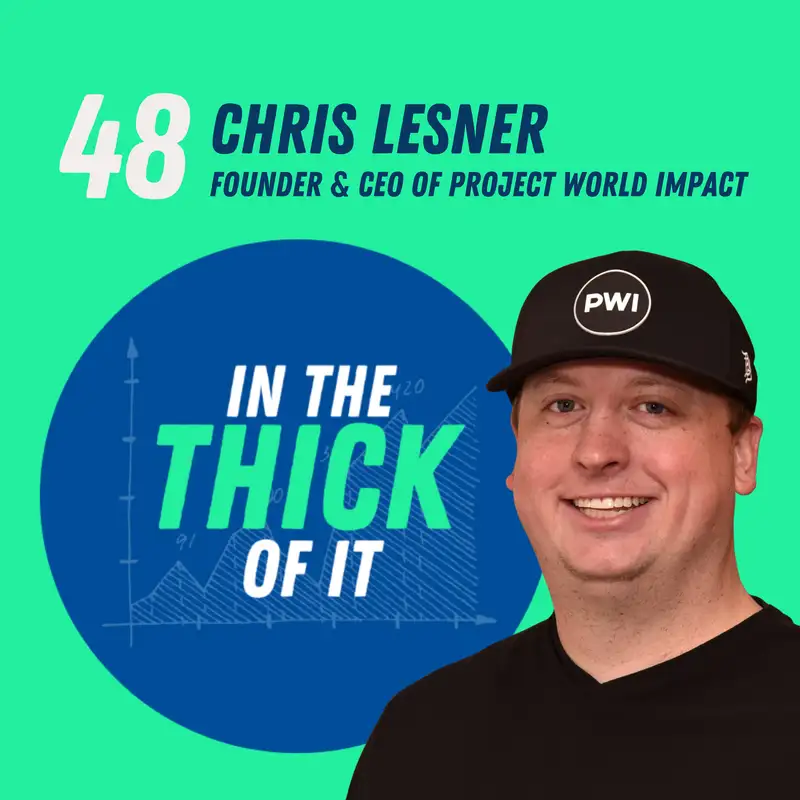
#48 Chris Lesner, Founder & CEO | Project World Impact
Download MP3Um, welcome back to in the thick of it.
our guest today, Chris Lester.
I had been looking forward to this for months.
We've literally been talking for months, trying to find a time to schedule.
He's been crazy busy.
I've been on the road.
He's been on the road.
and before we get too far in Chris,
is actually a big driver behind why we have come off of our long break.
We had a conversation a few months ago and he's like, man, you got to get this back going.
And that was such an encouragement to me.
And doing this podcast has been something that's been life-giving.
It's been something I've just enjoyed doing.
So thank you for the encouragement and the kick in the butt to get back in the chair and
get it going.
I mentioned, I've been looking forward to this for a while.
Chris is
One of the kindest, most generous people.
He is generous with his time.
He's generous with his resources.
He's the kind of guy that if you're in town, like he will drop everything and come and see
you and have a meal.
And he's just, he's just such a great human.
And so I am very, very excited.
smart, dynamic, energetic, and
And he's just got, he's got a great story.
So Chris Lesner uh founder and CEO of Project World Impact Brands.
Welcome to In the Thick of It.
Wow, thanks for having me.
And thanks for a great intro.
I should send that to my wife.
Hahaha
Well, man, we always like to start at the very beginning, where you grew up, how you grew
up.
And, I think part of what makes you so interesting is you've lived in a lot of places.
So where were you born and what were your early years like?
Yeah, I was born in Michigan.
And the long story short is I ended up in 10 schools over 11 years by the time I was 18.
And my dad was in corporate America.
And so he worked for General Motors as an executive.
And one of the things that came up to all the executives was, would you be willing to, or
you basically have to go internationally if you want to keep moving up at some point in
your career?
And so they said, OK, to keep
Moving up, we'll go internationally.
And long story short, when I was seven, moved to Japan and was there for four years.
After Japan, we moved back to America quickly.
Then we moved to Australia for a few years, moved to Germany, ended up, my dad retired in
2008 when the economy was gonna absolutely crash and GM was gonna go bankrupt.
They offered all the execs early retirement and he was like, yep, I should retire, be
close to.
grandkids and stuff like that.
we moved to Illinois and have been in Chicago ever since 2008 or 2009-ish.
And it's been awesome.
Where did you live the longest as a kid?
I lived in Japan the longest as a kid, which was great.
And the funny thing is, I actually ended up coming to high school in America halfway
through my junior year.
So somewhere we moved back to Chicagoland in 08, 09 area, and I was in high school.
And I came in as an international student, which was so funny.
And then going to university later,
I ended up getting an international student scholarship because I had lived most of my
life outside of America.
And so I would be put in these international student groups with all kinds of
international students.
And I'd be the only American kid.
And I felt so out of place.
But yeah, it was so fun.
Growing up internationally, I probably wouldn't want it for my kids.
But it was amazing for me.
Like, I just had the best experience in second grade.
There were kids in my class, 20 different nationalities.
It's a totally different experience.
And when you're living internationally, most of the families that live internationally,
from these big corporate companies that go to international schools, they're moving every
year as well.
So the common story is every year, everyone wants to be friends with everyone.
You don't run into the things where American schools where you probably have cliques and
stuff.
That's not as much of a thing internationally.
So I loved it.
That's really interesting.
I hadn't thought about like the clicks and, I guess just because everybody has so much
shared experience of moving, like you don't have those, those clicks.
That's, that's interesting.
so I got to ask, how many languages do you speak?
Now I barely speak any languages.
English even is hard for me.
But yeah, I grew up being able to speak Japanese, learn German when I was in Germany.
But if you don't speak it, it's almost impossible.
So I can still read stuff.
But even my comprehension is just so low.
I remember somebody was in town.
This is like a couple of years ago when I tried to impress them with my remembering
Japanese.
And I literally said something and they looked at me like, what the heck are you saying?
And I realized that I had spoken three different languages in the same like spiel that I
gave them.
Like I didn't even realize I was doing it, but it's just all blurred in my head.
yeah, only English now, but I can understand some other stuff.
If you were to go drop back into Japan for a week, would, do you feel like some of it
would come back to you?
For sure, some of it, but I feel like I'd need to be there multiple months before I feel
comfortable.
yeah, it's German would be a lot easier to get back into because there's so many
similarities to English.
uh I think I'd probably pick up that faster.
yeah, you can't be afraid to fail when you're trying new languages or yeah.
I do think that when you are traveling internationally, if you at least make an effort
that it's appreciated.
And thankfully in so many places, a lot of people do speak English.
So a few years ago, we took a trip to Costa Rica and it's been a long, long time since I
took Spanish in high school.
And I was shocked at how much I was able to like pick back up.
I wasn't very conversational, but like reading signs and
talking with with waiters and people like that, like I was able to I was able to get by.
Yeah, but it is crazy if you don't use it.
I mean, it's hard unless you're in that environment to pick it back up
Yeah.
So what were your interests as a kid?
Like, was it hard to get into sports or other kinds of activities?
feel like I was always drawn to sports, which also made it easy to make friends.
mean, you know, like when you're running around playing sports on the playground as a kid
or you're trying to join different teams, like if you are good at sports, you kind of
automatically have a friend group.
You know, my hardest move by far was moving back to America from into my junior year of
high school.
And.
These kids had been going to the same schools since.
kindergarten.
Like it was just something I had never experienced.
And the lifesaver was literally sports jumped in on the basketball team and was able to
play basketball and make good friends.
And then immediately was like, OK, I'm in.
uh But Tom, I mean, you're just living life hanging out with friends, uh having fun,
experiencing different cultures.
I wish in hindsight I experienced so many cool cultural things that
to me just seems so normal.
The other people from the outside and myself now I'm like, I wish I would have lived that
a little bit differently or experienced that differently because I just thought it was
normal.
I didn't realize how special it was.
Yeah.
Where was your favorite place to live growing up?
Australia by far.
I was 12 to 15 or 12 to 16, somewhere around there, when we lived in Australia.
And I had the most personal development growth ever, like during that period of my life.
I got such good mentors.
We were involved in like a church youth group and stuff.
It helped that English was already spoken.
But Australia and Americans, they're very different culturally.
So it still was a unique experience.
I had so many mentors and people like surround me, show me awesome love.
And it was just like, I loved it.
And the weather there, location, not that bad.
Yeah, no joke.
I've never been in this high, high on my bucket list to get down to Australia and New
Zealand.
like, I've always been, ever since I was like five years old, there's, there's just been
this kind of mystery around Australia.
And, uh, one of these days, hopefully, hopefully get down there.
the flight.
It's terrible.
So
literally having this conversation with somebody yesterday and they were talking about,
yeah, just how brutal that that flight is.
But once you get there, life changing, I'm sure.
Yeah.
so basketball, would you play any, play any other sports?
Basically every sport you can.
I tried to play some of everything.
The only one I got super serious about was basketball, where I was being recruited for
college and trying to play.
But everything else was just for fun and loved it.
Yeah.
Did you have siblings?
I did, but we had totally different experiences because my sister, who actually lives near
you in Dallas, she was 11 and a half years older.
And so we moved to Japan when I was seven.
And so she was, my parents literally waited to move until she went off to college.
And then she went off to college and we moved.
And so she never lived internationally, never, we had totally different childhoods,
totally different everything.
But it's nice that we can be close now.
Yeah, man.
Well, talking about school, mean, changing schools that many times, what, was that like?
Were you, were you a strong academic student?
Was it, was it tough to keep up when you're making changes that often?
Yeah, one thing people don't realize, I think, when they think of schooling, and it's
really obvious when you say it out loud, but the way people teach subjects across the
world is very different.
Even like in, I don't actually know how America works because I wasn't in school here, but
I think people learn like in math, for example, they'll learn like algebra, geometry.
uh Trigonometry like whatever and like it'll every year they'll learn a different thing.
Well, for example in Australia You start with a base knowledge of every type of math and
they only go through like a month each on everything So you're not really gaining tons of
skill, but you're being exposed to it Then they build on all of them again the next year
So there were certain things whenever I would transfer schools to any other country and
like 10 schools in 11 years I was moving schools a lot There were things that were like
Sometimes in certain subjects, I looked like an absolute genius because I had learned
things that no one else in that grade had learned.
And on the other side, I was so far behind in other things.
It was unbelievable.
I remember like my ACT, for example, testing out of high school and reading.
I love to read, but reading and grammar in America is different than anywhere else I had
learned it, even just punctuation, how they use different like.
spelling, things like that.
My math score, I think, was in the 30s.
My science was like high 20s.
My English, my reading and spelling, or whatever the two English ones were for the ACT, I
got like a 10 and a 12 out of 36.
And so that made it really complicated applying for colleges because I didn't look like I
had basic understanding of reading and writing.
So yeah, it was always interesting, but always a lot of fun.
Thankfully, I was surrounded by good teachers.
mean, you know the difference a teacher can make in your life.
And often at these international schools that I was placed in, people sought them out to
go teach there.
So you had some of the best of the best teachers who really loved kids.
The learning was important, but secondary, probably.
It was more about loving on the kids well.
And so I can't think of even one scenario where I had a teacher that I didn't like all the
way through my school career.
one of the things I've observed about you though, is you're also an incredibly positive
person.
And, and I think that you, you probably just naturally see the best in people too.
And that, that mindset, that mentality helps a lot.
Yeah, definitely.
There is a lot you could be negative on.
So no point in living negative.
Yeah.
Well, so you come back to the States in late in high school.
you said you started your junior year.
came part way through your junior of high school and, living in the suburbs of Chicago,
right.
and you said you've recruited for basketball.
Did you end up playing basketball in college?
Kind of.
I tell people no, but kind of.
I technically started on a team when I went to university in Indiana, small school.
And then when I realized like, this is not going anywhere, like I'm not going pro, and
there's two a days, and I basically have to give my life up for basketball in college, I
quit before the freshman season started.
It was just one of those things.
There was no way I was going to.
actually pursue it even even though it's fun to play it was just as fun for me to do
intramurals and win the championship of intramurals every year like that was just as fun
so without all the practice so
I've got a couple of friends who have kids that are getting ready to go off to college in
the next year or two, and they're both playing football and they've got one friend and the
other friend, have very, different mindsets about how their, kids are looking at it and
how they're looking at it.
And kind of where I fall is if, if you're not going to go pro, if your prospects of going
pro are small.
You really ought to pick the school that you want to go to and maybe you go try out for,
walk on, you know, walk on tryouts and if you make it great, but I feel like you're much
better off if you're, if you're not headed to a pro level, go to the school that you want
to go to, get the education and focus on that.
And if you can, you know, be involved in athletics, great, but don't base your decision
off of that.
Does that resonate at all?
Yeah, yeah, for sure.
I mean, the odds, like if anyone's in a D3 or D2 school, like probably not going pro.
Most people in D1 probably don't realize they're not going pro, even though they think
they have a chance.
Like our high school basketball team, I think we set the state record for wins my senior
year.
We were really good.
All five of us had been recruited for various levels who were starters, and even some of
the bench players were recruited.
for multiple sports.
So we had a really good team.
And I think through the best of us, we're never going to make it.
And we were like the best in the state, right?
We were really good.
And our best player, who was awesome, he could have played in the NBA.
And that's great.
But even still, would have been a real challenge for him to go play.
He had offers to play in Europe and had an agent talking to.
But yeah, I mean, you don't realize how difficult it is to get there.
because you look at some of these players in the NBA or choose any sport and you're like,
man, their third string or their backup to the backup, like whatever, they must not be
that good.
They are still amazing.
I don't know.
Have you ever seen the Brian Scalabrini YouTube stuff like the guy who used to play on the
Boston Celtics and people would always make fun of him because he was terribly rated in
like 2K and stuff.
But but he would go do these one on ones because people always called him out for being
terrible and he would shut.
really great college players down 11-0 every game.
Like they just had no chance.
And he was like at the bottom of the totem pole, if you will, in the NBA.
But it's still just another level.
Yeah.
There's, there's, there's only one LeBron.
There's only one Jordan.
There's only one Kobe and yeah, making it to that level is it's, you know, the half a
percent of a half a percent of a half a percent that, that get there.
So tell me the name of the school where you went to.
University in Indiana.
Okay, small school, big school.
super small Christian school.
Taylor is one of those schools that nobody's heard of.
It's right in between like Indianapolis and Fort Wayne and surrounded by farmland for an
hour in every direction.
I was not planning on going there.
I thought I would end up at basically any other school.
But I ended up visiting Taylor.
I was more just visiting it to accomplish a visit because that's where my sister had gone
a long time ago.
But I didn't actually have tons of interest in going there.
but it's a Christian school.
And one of the things that they do on the tour is they walk you into a chapel as the
students are having chapel.
I wasn't even sure if I wanted to go to Christian school because that has all kinds of
potential negative connotations in my mind.
But when I was thinking about this, all the Christian schools that I had heard of,
chapel was a requirement.
So you'd have like thousands of students at these chapels, but it was required.
Taylor, wasn't required.
And so I walked into this chapel.
And I kid you not, they have chapel three times a week.
Over 98 % of the students go to three chapels a week.
And so you've got thousands of people in this building having chapel service, listening,
whatever.
And uh when I walked in there as like a prospective student, if you will, I was like, man,
like,
I can feel that this is where I'm supposed to be like if this many people are trying to
better themselves in any direction willingly, I think I will probably do OK here.
The irony is, chapel is what got me to Taylor.
I started working while I was in school and I didn't go to chapel for like two years
straight, which is so ironic.
But uh but it's not because I didn't like it, just I was doing other stuff.
But yeah, I had a great school experience and my
I knew my wife before we went to Taylor.
We were both dating other people.
But we both ended up at Taylor, and we're good friends at Taylor.
And such a blessing now that then we started dating later in college and got married
later.
That's awesome.
What did you study?
I studied international business.
That was my major.
And it was purely because I'd lived internationally and I liked business.
And I had no idea what that meant.
But it seemed like.
grown up through the lens of your dad, like it didn't, it didn't click.
you know, I always told my dad that I had no interest in working for a big company.
I always wanted to start something.
I didn't know what it would be, but I always said I wanted to start my own company and
that I didn't want to work for a corporation.
We had a great life.
Like, I loved my life growing up.
My dad had a great career and we just had a lot of fun.
But for me, the idea of
fitting into somebody else's thing just didn't feel like what I felt like I was called to
do.
So international business was interesting, but it also felt pretty corporate of like, this
is going down the route that feels really familiar.
But thankfully, I don't know your experience with school, but mine was like, I got a piece
of paper and I'm thankful for it.
But at the same time, all the learning came after school.
Yeah, some that I've talked about a number of times, I went to Texas A &M and at A &M they
talk about the other education and at A there are literally thousands upon thousands of
student organizations and I was involved in tons of different things and I definitely
learned in the classroom, but I learned way more outside of the classroom than I learned
in the classroom and I'm grateful for the education.
But I'm far more grateful for those experiences that were the extracurriculars and the
opportunity to, you know, develop myself as a leader.
And that all came through being involved on campus, not just what I was learning, you
know, in the books, so to speak.
Now, you mentioned working.
You started your first business while you were in college, if I remember correctly.
Yeah, like I said, I always want to start something.
I had started so many different businesses.
They weren't real businesses.
to me, high school even, it was like, man, this is going to be a billion dollar company.
And it was a terrible idea.
And there were dozens of those.
And it just so happened that one, I was able to start a couple of things that got some
traction.
And one of the things that I was doing was
I guess you could if you've if you've heard of like Linda or Khan Academy or things like
that where it's our masterclass is a way better example Like where you go and connect with
people have them sell their course and then you sell their course online like we were
building a platform to do that mean a couple people and Honestly, it was going nowhere
Literally nowhere, but somebody else saw it and said hey, we're building a marketing
company well, actually
That's not what they said, but ended up being a marketing company.
They're like, hey, we're going to build something.
So I went and joined them instead.
And then there are other students who just saw and they thought that we were already
successful when we weren't at all successful.
So it was an easy ship to jump.
And then I jumped on with these other students and what they were doing literally shut
down like two months later.
And then and we're like, well.
Let's think through what would it look like to create something and and one of there were
three of us who were part of starting this thing and One person was in charge of what
would be all the clients one was in charge of sales and I was going be in charge of
marketing and I remember sitting in my first meeting with a potential client and there and
really we just went to
to alumni of our school and said, what would you need help with?
And we offered a lot of work for free just to learn along the way of like, what do people
need?
And what could we learn doing?
And everyone, because we were young, we're like, hey, we need help with social media.
We need help with our website.
We need help with search engine optimization, all this digital stuff.
And I remember my first meeting, somebody saying like, we need help with SEO.
And I'm sitting there and I'm like, yeah, yeah, that's great.
We'll for sure be able to help you with everything you need.
I literally go home and Google, what is SEO?
Like I never heard of this term and they kept using it talking about how important it was
for their business.
like, and I just became like obsessed with trying to solve these people's problems.
And thankfully, they were giving us time marketing problems.
And so we kind of started something without even realizing what we were starting.
And then we're kind of talking about like, what should we call this?
And as over at my buddy's house, and I'm just like, the only domain I can find.
is Think First Marketing.
There is no other marketing domain available.
So I ended up creating something called Think First Marketing and building a marketing
company while I was in school.
that really helped set me up well for just the journey ahead.
And you were 20 years old at this point.
Yeah, 19 or 20.
Yeah.
Wow.
Sitting across the table from these people that are business owners or leaders in the
company, what are they thinking looking at a 19, 20 year old, like pitching them on
something?
I think the beauty is we weren't really pitching anything other than to help.
So they would lay out a problem and then we would say, yeah, we can help.
And I don't know for how long, but like probably for the first six months, I don't think
we were getting paid for anything.
You know, we were just literally learning along the way, but we got paired up with so many
good projects that people give us that I remember there was one brand that was shutting
down.
And it was part of a massive company and they were selling CD cases.
So CD cases were going out of style, obviously like crazy.
This would have been in like 2011-ish.
So like CDs weren't a thing.
And they were shutting down this business, but they had tons of inventory to get rid of.
And they were like, we're going to shut this down in the next quarter.
And we ran a marketing campaign that was so successful for them to
liquidate their inventory that then they kept the business going for another year just
because it actually was profitable and we got looped into other companies that the parent
company owned and they it's major brands that you would know that we got to work with and
it was like man we're just getting looped into all kinds of crazy things and and I think
initially where it started as we were learning at some point we really did become
more knowledgeable than the people hiring us by quite a bit because we were playing with
other people's money, you know, for the first six months to test it out.
Man, fake it till you make it and just grind and learn.
I love it, man.
I love it.
So you graduated from Taylor and did you continue with Think First or did you jump right
into Project World Impact?
So that's a great question.
When I was starting my senior year, I was in a different position than most college kids.
My senior year, we were talking about doing well over $10 million.
My senior year, we were opening offices across Indiana.
We were going to go through, yeah, we were going to rebrand.
We had a bunch of big clients.
The thing was growing.
And my senior year was going to be awesome.
And so I'm trying to figure out.
What should I do with my life?
I'm in a different position than basically all these, all my friends where I'm kind of
set.
I know I'm going to have a job.
I already have a good amount of money, especially for a college kid.
I just need to figure out like, what does God want me to do with my life?
What do I think I should do?
And so along the way, one of the things that was super beneficial is I had always sought
out good mentors.
And that's like how I learned marketing from people who are way smarter than me.
like just getting life advice.
And one of the people that I was seeking advice from was a person who was in the nonprofit
world.
And we were giving this organization money.
And it was really interesting because the guy who ran this nonprofit, it's a nonprofit
called Compassion International.
They do a bunch of child sponsorship and stuff.
But no, no.
Yeah, now I think they're a billion dollar a year nonprofit.
So they're they're not small.
But the guy who was running it, we were talking and I was asking for advice.
And and he very clearly said, what if you stopped giving us money and figured out a way to
use your marketing skills to build the kingdom and help people?
And the guy was a Christian like myself.
And so it was like we were talking about like, what would it look like to use marketing
for good, basically?
And and I was like,
I don't think marketing can help people.
I think we're really good at making money and we can give a lot of money away.
Like we're making tons of money, we can give it away.
But the question really messed with me of like, is all I'm supposed to do make a ton of
money and give it away?
And something didn't sit right.
I couldn't think of a situation where...
I had heard that from the Bible or from wherever.
And like that was somebody's purpose was just to get rich.
And I'm like, man, there has to be more to this.
And so I started just praying through what should I do?
And I think within 30 days of starting to pray that I felt immediately like I was supposed
to leave.
And here I am starting my senior year in my head and heart.
I'm like, I'm supposed to leave, but I don't have anything else lined up.
I don't have to really worry about getting a job yet, but at some point in my life, I'm
going to need a job.
And so I left Taylor halfway through my senior year.
And when I left Taylor, also I just needed separation completely.
So I left the company that I had helped start.
And I left Taylor and just said, I'm going to start something totally different.
And it's going to be focused on helping people.
And yeah.
real quick, didn't finish school?
Well, that's, you don't even have enough time to talk through that.
Somehow I got a degree, thankfully.
It literally, I didn't know this, but when there's serious cases, I guess, brought to the
school, the deans all get together of all the different departments and vote on it.
in my situation, when I was posing that I would like a degree from Taylor, but I'm happy
to get it from anywhere else, like I just wanted the paper.
It got put before all the deans and they voted and I literally passed by one vote.
People were on both sides and one person who didn't know me at all, never had met me,
voted that they thought the purpose of the degree is to get certain life experiences and I
had made a good enough case that they would have been happy with me as an alumni and they
gave me a degree.
yeah.
And I think it was like, yeah.
It's too long a story, but it was really cool to get into it.
So technically, I'm an alum of Taylor, which is great, even though I didn't finish my
senior year.
Were you like a semester short?
I had all the credits, but I didn't have all the requirements.
So the irony of this is so ironic.
There were 16 credit.
I had passed all the total credits needed, but the 16 credit hours that I needed,
technically to be an international business major, you need to take 16 credit hours of
language throughout your four years, which I had taken no language.
But the other irony was I already had taken Japanese and German like my whole life.
It was just one of those things of like, what's the purpose?
Is it really to be sitting in the classroom or was it to like understand culture and
language?
And the case we made was I probably have more cultural experience and had actually lived
out the language requirement better than most people would in four years.
So yeah, it worked out.
That's awesome.
Well, I interrupted your flow there.
So you leave partway through, you walk away from the business and, I guess real, real
quick on that, what did, what did your, your partners do?
Did they, did they continue with it?
Are they still running with it?
Do you still have relationships with those guys?
Yeah, were, the three of us got along so well and obviously the team had grown like crazy
by that point.
But it was one of those things of there was always this tension, a healthy tension which
you need in a business of everyone wanting to push the business in slightly different
directions.
And like I said, the three of us, one was in charge of all the customer stuff and she was
amazing and brilliant.
The sales person who really was the leader of everything, he was genius and could sell
anything to anybody.
And I was in charge of marketing.
And so when I said I was leaving, it left this big hole in the marketing side, which was
the core of the business, right?
It was a marketing agency.
We didn't start that way, but it ended up as a marketing agency.
And so within a year or two,
The company, there's a lot I wish I did better and could have done better to probably set
them up for more success, like train, like try to figure out and help hire or replace more
things like that.
But I was so set I'm leaving.
And to me, like the company never mattered.
It was like, what what are we actually accomplishing that mattered?
Like the work itself didn't matter that much to me.
And so within a couple of years, the company
Changed completely away from marketing The the lady in charge of all the client stuff.
She went to run a massive marketing division of a much bigger company in Indy even and
they ended up turning into like a crypto company and doing some other stuff and in the the
sales guy bought equity in a bank group and
owned a bank and did other stuff.
we all kind of like we're moving in different directions once I left and that kind of was
the nail in the coffin of this thing is not gonna last I think, along with just different
desires for where we wanted to go.
Okay.
But sounds like no, no regrets.
And you left school.
Did you go back home?
Yeah, so I moved back in with my parents and I just said, I think I'm supposed to build
something, but I don't know what.
And as I prayed through it, there was something that I had pitched in a, like, I don't
know if, I'm guessing A&M had this, like, did you guys ever have like business
competitions where people like would pitch business ideas?
Is that a thing?
So it is now, I don't remember it being a thing when I was in school.
And one of the things I was thinking about when you were telling your story about Taylor
and getting to meet with these alum and talk with them, was that something that was
encouraged?
Was there a program for that or was this something that you and your buddies just kind of
did on your own out of your own personal drive?
Yeah, no, it was like out of necessity and personal drive.
It was not something that was like super encouraged at all.
I remember somebody was giving us our first Google Ads project, which again, I didn't even
know SEO was.
didn't even know what Google Ads was.
Obviously, I'd used Google, but I no idea what Google Ads was.
So I'm Googling, who are the best people at Google Ads?
What's the best company at Google Ads?
Blah, blah, Turns out a Taylor grad.
was one of the leading experts in spending a significant amount of money in Google Ads.
And so I just reached out to the students that I'm starting a marketing company.
Can I just come sit in your office and like, I'll work on other stuff.
I've got plenty to do.
I'm not going to bother you, but I just want to see what you do.
And he's like, sure, come on down.
And instead of just like letting me see what they did, they invited me in and said, like,
here, let us have you sit in our meetings and show you what we're doing.
We'll talk through stuff.
And I like, I just ended up being a sponge.
And that happened like,
over and over and over about basically everything.
I would just try to find out who's the best in the world at this and try to connect with
them.
And people were so gracious with their time and just generosity with their talent and just
like teaching me when they had no benefit to do so.
That's awesome.
So let's go back for just a second.
You when you made the decision to leave Taylor.
Call mom and dad, hey, I'm I'm I'm not going back to class.
I want to come home.
I'm doing this total pivot.
What was that conversation like with your parents?
Yeah, my parents always said, we don't care what you do with your life as long as you get
a 3.5 GPA.
Like that's all they required.
So they didn't care if I was working.
Even I remember the first call I made when I was talking about leaving that education type
thing that was going to fail miserably to go start what ended up being a marketing
company.
And my dad had two questions.
One was, how much money do they want you to bring in?
And I'm like,
None, I'm just like going to work for free.
Like, we're just going to figure this out.
And he's like, all right, as long as you don't have to give a bunch of money, that's fine.
And the second was, can you still get a 3.5 GPA and do that?
I was like, I guess.
Like, I'll figure that out.
So literally, I did not go to classes at Taylor for, which also was a down point for me in
terms of trying to get the degree at the end.
But I didn't go to classes for a couple of years.
I would just show up for test days.
And I would try to choose classes where I'd
didn't have to go to the class where I could just do tests.
And I'd ask people for notes and try to study quickly the night before.
yeah, school was interesting.
But my parents knew I was totally checked out of school and totally had moved on into real
world business.
When they saw the clients we're working with, mean, we were getting to work with amazing
Fortune 100 brands doing digital marketing for them.
The experience was just,
next level, they knew that it wasn't laziness.
I think it was just totally deferred interest.
And I think when I had always joked with my dad, well, maybe I was serious or who knows,
but I had always said like, I would love for him to come work for me one day as a kid.
Like I was just, it was like a common joke.
And so it was funny because
When I left our first company, I took a bunch of money, which was going to help me start
whatever I was going to do.
And I started talking to a bunch of potential investors, venture capitalists, who were
offering us crazy amounts of money to start something.
And I didn't even know what we were starting, but they had seen what we grew the first
time.
And they're like, we just want to invest in you.
Whatever you're to do, we'll give you hundreds of thousands.
We'll give you a million.
We'll give you whatever.
Just tell us what you want, and we want to be a part of whatever you build next.
I asked my dad, can you just come sit?
He was retired.
And I asked him, can you just come sit in on these meetings?
Like, I need somebody who hears the same things and can help me discern, is this a good
idea or not?
And there was one firm specifically that I was going to take a lot of money from to start
something, which I guess was going to end up as PWI, what we're doing today.
But it wasn't at all where we thought we were moving, day one.
And where we are today are like two totally different ideas, but technically the same
name.
But I remember we were sitting in this VC's office and they laid out a number.
They said they wanted 20 % of the company of whatever we were going to start.
And I was like, that is more money than I could have ever imagined for an idea.
Like, I didn't even know that an idea could have value when we have no revenue, no
business, no staff, no nothing.
And my dad and I were looking at each other we're like, this is good deal.
We left.
I was praying about it, thinking about it.
I'm like, you know what?
I have enough money to fund this.
don't even know what it is.
I don't want to be beholden to somebody else's idea of making money.
Like we already could have done that if I just stayed at the first company.
And right when I told my dad, I think that I'm not going to do this.
He hadn't given me any opinion.
He's like, if you don't do it, I'll come work for you and help you build whatever you're
building.
so literally, I went and thanked him, obviously said I'd love to stay in touch because.
They had a lot of money and I would like to stay in touch.
And just in case.
And yeah, so literally from that day forward, like Bill, my dad came on board and has been
with us literally still with us.
We're like 12 or 13 years in and he's still with us today.
Yeah, which has been a fun journey.
That's amazing, man.
And I mean, it takes a lot of maturity, especially at a young age to say, you know what, I
think I can get this far enough without having to take other people's money.
And clearly you knew what comes with taking other people's money and the foresight to be
able to say, you know what, I'll forego that.
I'll bootstrap it with what I've got.
And
kudos to you for having that, that mentality, that, that young and that early on, that's
amazing.
before we get into PWI, you mentioned you and your wife were dating in college and were
you dating at the point that you guys left Taylor or that you left Taylor?
Yeah, so we both broke up with other people our freshman year.
And she broke up with her boyfriend.
And this is the irony.
Her boyfriend and my girlfriend were going to the same school.
And so me and Jen would drive to that school together from Taylor to go meet up with our
people we were dating, who were both great people, just as people.
And it became really clear on those drives that even though those are
great people, they're not the right people for us, at least in my mind.
And Jen had not come to that conclusion yet.
But I wasn't going to let a good thing go necessarily.
And I waited, and Jen ended up breaking up with her boyfriend freshman year.
And I was like, OK.
So then I broke up with my girlfriend.
then we waited.
Our families are really close.
My best friend in high school, how we knew each other beforehand, my best friend in high
school was her cousin.
So.
I had already known her family.
knew her grandparents.
knew a lot of her aunts and uncles and cousins.
They run a large manufacturing company, I guess you could say, or group of companies.
And my dad was on the company board at the time.
Our families were already really integrated.
Even though we were interested in each other, we didn't start dating until sophomore year.
We decided we'd wait almost a year to date.
And then we dated all the way through college and we waited.
Well, since I dropped out of senior year, we even waited a year after school because I
didn't know what I was going to do.
I didn't want to get married and be starting a business and risking a lot of money and be
married at the same time.
So we even waited a year after school before we got married.
So we dated for.
maybe 4 years.
And what is, what is she thinking in this process of leaving school, walking away from a
successful business and, and, and, know, what are, what are her parents thinking?
Like, Hey, sweetheart, are you sure that Chris is the right guy?
If, if he's dropping out of school and, and walking away from a business, like what, what
were those conversations?
Yeah, I don't know how to explain it.
You often hear of awful in-law situations.
My in-laws, like my father-in-law, became one of my closest mentors in this process.
So my mother-in-law were really close as well.
They ended up speaking into and helping me process the decision.
So it wasn't as
uh daunting, don't think, as if it would have just been cold and like we had just been
dating and weren't close with each other's parents, like her parents probably would have
freaked out.
But because they were part of the decision making of and helping me pray through and think
through it, we all felt at such peace.
know, there's there is a song by somebody that I like and it's this person talking to God
and they're like, talking to God, is this what you wanted?
You've given me a false sense of peace to show me what peace really is.
Right.
I think from a worldly standpoint, we had tons of peace.
We had money, we had success, we had whatever.
But that's not really where peace is.
It was more for me about being in the center of what Jesus was asking me to do.
And I just felt so clearly convicted of this is what I should be doing.
I remember before I even told people what I think I should be doing, I went to five
different mentors who all were extremely successful business people like
you'd know the companies if I said their names.
And I laid out the pass.
I can keep doing this marketing thing, or I could start something else that would not be
focused on money, but have potential to impact hundreds of millions of people.
What do you think I should do?
And I honestly went into all five meetings thinking they would say, well, if you keep
making this amount of money, you could impact a lot of people.
So you should keep doing that.
And all of them were pro-business people.
And five out of five said,
I think you should stop marketing as fast as you can.
You should just go do this other thing.
And in the end, we restarted a marketing company and did other stuff under that.
But I had so much confirmation along the way from mentors, Jen's parents, Jen.
There was so much prior thought that went into it that it just was so obvious that it was
the right path for me.
So what became PWI started with a business pitch competition in school.
That was the seed idea.
So there were, I had two ideas for this business pitch.
And I'm like, which one should I do?
So I decided on what if we could build a website where we could help people find
nonprofits by cause and location.
And that was the premise of one of the ideas.
The other one was a different business.
And I decided I'm going to pitch this PWI thing where I can help people find nonprofits by
cause and location.
We'll charge
like finders fees as we find donors kind of thing.
That was the gist of the idea.
The other business idea, I told my next door neighbor and said, hey, you should do this
thing.
We went into this business competition and I came dead last.
My other idea beat me and placed and got money.
So it's one of those things of like PWI was a bad idea to everyone on the outside who like
knew anything about it.
Because really it was like there was no business model.
And even for our first seven years, maybe eight years, we, I guess seven years, we made
zero dollars at all doing the thing that I had initially started it to do, which meant we
had to start other companies to help fund the actual vision, which later has turned out
fine.
but it took seven years and a ton of money to actually make something work.
So it was probably good that it came in last place.
Nobody should do what we tried to do.
It was a bad business idea.
But even like when people look at our vision as a company, it's super simple.
It's honor God and impact people.
And our mission is to impact hundreds of millions of people.
And so it's a pretty easy filter for us to decide if we're gonna do this, we have to think
it could impact hundreds of millions of people.
We're not going to get involved in something that is a good thing and can make money if it
can't impact hundreds of millions of people.
So it's been a good filter.
But trying to impact that many people is normally not profitable for a long time.
Do you have a counter?
Like, do you know how many people you've impacted today?
Yeah, it's an unfair counter because we ask, we ask our one of the businesses under the
umbrella is like a nonprofit hub where nonprofits now do common people like over 20
million people have used this site to find nonprofits by calls and location.
So it's turned out cool.
We ask all those nonprofits, how many people a year do you impact?
The problem with the question, which we now know the problem is that you might have a
single mom living in the local community who she's getting help by a nonprofit with
housing, with food, and with after school care.
All three of those nonprofits will tell us we help one person each.
So we say three people, but really it was one lady, you know.
So the counter we have shows based on nonprofits telling us what they do on that side,
that they alone, that one little portion of our business, they impact 14 billion people,
which is more than there are on the face of the earth.
um So Billion, yeah, so the problem is we're double counting a lot of people not knowing
it long term.
We hope to solve that too but yeah, we're making some substantial impact even just with
that one arm of six different things we're doing so
So PWI started with this vision of connecting donors to organizations based on location
and common, you know, common mission and mentality.
But other things came out of that to actually monetize the overall business.
What was that first venture outside of kind of that core, you know, connector type
product?
Yeah, I remember telling everyone I knew Jen like my wife my parents everybody like I'll
never get back into marketing You know, like it was a great run made a lot of money.
I'm never gonna get back in I just had no interest So we're we started PWI in 2013 in 2014
I hired 20 some college interns to go cold call nonprofits and over the summer
They called 80,000 nonprofits, inviting them to join what we're doing.
Just literally cold calling and, hello, hello, hello.
Just super simple.
I hired a company with about a third of the money that I was bringing into the company to
build this website, which would be like a game changing website.
It was a pretty complicated project just because you'd have tens of thousands or hundreds
of thousands of nonprofits and how do you connect people well to them.
So it was more complex than just building a small website.
So I gave them about a third of my money and they were gonna be done in May of 2013.
And the college students would start May of 2013 and work through the summer, which was
great.
Unfortunately, in October of 2013, that company, all their development team had left to
start another company and they were gonna go bankrupt.
So we had nothing, I lost a third of my money and I was like, oh, this is not good.
We are absolutely screwed.
And we've promised thousand,
tens of thousands of nonprofits, a website that doesn't exist, not realizing we were not
telling them the truth.
Like it was just a nightmare.
So we hired a second company with the next third of my money and they scoped out the
project.
got, they started working on it and they realized we don't have the team big enough to
build this.
So they had to self-select out.
So I'm two thirds of my money through by the end of 2013 and we have nothing.
other than we've made a promise to tens of thousands of nonprofits for something that
didn't exist, unfortunately.
were those nonprofits, were they paying you anything upfront or was it all contingent on
Yeah, it made it way better that they weren't paying us.
But at the same time, we looked like liars.
I remember we had sent out so many, here's the launch date emails over the course of 2013,
because we genuinely thought like, we'll be live by August 1st, September 1st, October
1st.
And we had explained what was going on.
And at some point you realize these people, like,
Customers probably realized before we did how this thing was not going anywhere, at least
in 2013.
So in 2014, I'm out of two thirds of my money.
And this gets back to like, how the heck did we start the next thing?
Part of it was out of necessity.
So I'm like, I'm running out of money.
We're paying these college students.
We have full-time people.
I'm going to be totally out of money here pretty soon.
And we have no revenue model.
Like initially, this was all just
Like to help like there was no revenue model even for the nonprofits that were committing
we just told them join for free There was no revenue model at all at this point I thought
the money would last for a long time and didn't expect a bunch of issues And part of that
was because our first company was just service-based like we were just a marketing agency.
like If it went wrong, we just spent more time on it.
But like we never had any hard costs other than people
when you get into software and other things.
mean, you know, there's real cost involved.
And yeah, so I ended up, went and asked, I asked a friend who I knew worked with a lot of
nonprofits.
said, could you connect us to a lot of nonprofits?
We're trying to build this thing.
And this is somewhere in 2013.
And I still think the site's going live that year.
And she brings me into her leadership team meeting.
This is an organization that's like $50 million a year organization.
but it's a well-known group.
And they said, we will connect you to nonprofits, but we need your help on marketing.
And I'm like, at this point, I was down a lot of money.
And I'm like, I guess it couldn't hurt to take on one consulting gig.
And my consulting gig could probably fund us for many months if I could keep doing this,
and that would be good.
So we took on one gig.
And then it was like, well, why would I not tell a couple other people, I'm slightly back
in the marketing thing.
We can take on one or two more projects.
And immediately when I brought that up, multiple people started hiring us.
So without knowing it, the second venture ended up being a marketing company, which now
has grown substantially.
But at first, it was just like I needed to make sure that we could pay people.
And we're heading into 2014.
We have no site.
I'm down two thirds my money.
We do have some marketing clients now, so we've extended our runway.
I contact a guy who, I think you've met Ben, uh who's part of LX, Ben Clark.
And I knew him from when I grew up in Australia.
He was a youth group leader.
He was part of the youth group and he owned a tech company.
And he was just known for having exotic cars and like all the kids would be like, can I
drive in your cars and like look at his cars and stuff.
And so I reached out to him and said, listen, I've lost most my money.
I don't know what to do related to technology.
I'm really good at marketing, but I don't know anything else.
What would you do if you were me?
And he's like, you know what?
I think I'm supposed to sell my company and come work with you.
So literally six months.
This we started this in 2013 and he moved here in like 2014, I think.
You called him for advice and he just at the drop of a hat was like, I think I need to
stop what I'm doing and come join this.
I mean, he happened to be on vacation like two months later in America.
And he's like, let me just extend my trip with my wife and we'll come to Chicago and I'll
help you think through it.
And I guess this was in 2014 because he came in 2015.
So my timelines might be a little off, but it's the gist.
And yeah, so literally he sells his company and come becomes our CTO.
We have no money to pay him.
But it's like he bought into the vision of man, what if we could really impact hundreds of
millions of people through marketing and tech?
Unfortunately, I had signed a contract with our third company before I knew he was going
to come, think.
And we start working with this third company.
He comes in, starts to manage that project, and they held all of our stuff uh as
ransomware.
So we didn't know it was a reputable company, supposedly big company here and had
international stuff and held all of our stuff for ransom.
Our domain, everything, and they just said like,
You have to pay us a large lump sum of money, and they hadn't really done anything, or
we'll keep your stuff, basically.
And it was a nightmare.
So there goes the last third of my money.
So I'm like less than two years into PWI, and we have lost all of our money, like
literally all of it.
And the second part of our business, I ended up realizing we need to scale this marketing
side fast.
Because if we don't scale this thing, we can't pay people.
And if we can't pay people.
There's no business.
so really long-winded answer to say we ended up getting back into marketing, which I
thought I'd never do.
And Ben moved here.
And when Ben got here, literally everything started going way better.
But it was a long journey to get there.
uh
of the things that I learned a long time ago is never say never.
And if you say never, you will eat those words at some point.
it sounds like you've experienced that too.
How did that end up shaking out with this other company?
Did you end up paying them out or did you end up going to court?
How did that shake out?
So we asked our lawyers, obviously, what do we do in this situation?
And they kind of left it in our court.
Of course, we could win a case.
And they did have an entity here legally in the US.
But based on it being basically a scam operation, there probably wasn't much to it that we
could win.
And the amount of time it would take to actually go through procedures could be years.
And so they're like, we can do that for you.
You will probably spend more in legal fees than you will in just paying them what they
want or walking away completely.
And so it was very clear, don't go the legal route.
That was going to get really expensive.
Should we pay them what we want?
Will they even stay true to it?
So we did all through like escrow.com and they got paid for stuff that they should never
gotten paid like for nothing just to give us our stuff back.
And then, yeah, it was it was a nightmare.
Man, that is a wild, wild story.
And one of the things behind this podcast is we want to create a platform for people to
tell the stories of their trials and their triumphs.
And man, that is a heck of a trial to go through.
Yeah, you know what, looking back, it is crazy how much money we lost, how bad it was at
the time.
I mean, and you know this running a business and I think anyone listening or anyone that's
been on it who's run a business, like it kind of feels like you're getting beat up all the
time.
So you don't even realize when you're getting beat up worse than other times because
you're like, it's just the next fire.
You know, all of it felt so normal that looking back, it was like, man, I can't believe we
made it like that.
We even existed.
But
There was just a crazy sense of peace.
Like, I knew I was exactly where I was supposed to be.
And I really didn't have any concerns.
I also, thankfully, at this time, I'm like 22 years old going through all this stuff.
And like, what 22-year-old even has the opportunity, or 23-year-old to even have the
opportunity to lose a bunch of money and not have to stress about it?
I was thankful at this time that I was still like with my parents in their basement versus
married for this exact reason.
And once we got stability, we knew we'd get hitched at some point.
So yeah, it worked out.
man.
So you get the marketing thing going and is it safe to say that that was the primary
revenue driver for quite a while.
Yeah, for at least seven years, maybe eight years, that was the main funder.
And for better or worse, that side grew really quickly.
And to some extent, we fell back into like, well, this is just easy money.
And we're winning for our clients.
Clients are happy.
We're happy.
This is a great business model.
And it's really hard to go back to the thing that loses money and causes tons of problems
over and over and over.
But we also felt like we were supposed to do it.
That was a slow go.
That nonprofit stuff didn't start making money until maybe 2020.
And we had started in 2013.
So it was a rough go for a while.
And yeah.
marketing, were you working just with nonprofit or were you doing for-profit marketing as
well?
No, and that gets a little bit confusing because the marketing was mostly only for
profits, big brands that you would have heard of, Fortune 500s and other large brands that
we get to do their digital marketing.
We did have a couple of nonprofit clients, but the bulk was for profits.
And it was funny because we had a name like the name was Project World Impact.
And so the first time we would invoice people and we, a lot of these were past
relationships where we'd send the invoices and we get
billing notices back from the team saying, hey, we're not doing charity work or like tax
deductions because the name just looks like a nonprofit.
But technically, everything we're doing is under a for-profit umbrella.
And so it's just one of those things.
It was a funny journey, but super thankful for the clients we have.
about rebranding the agency side of things to overcome that?
Totally.
there's, yes, is the short answer.
The long answer is I'm glad we haven't.
We don't have salespeople.
We don't have like some great sales thing.
The reason people work with us is because they know us or because somebody they know works
with us.
And then they hire us like a good example of us not selling anything.
but getting multiple clients out of it.
And this is all of our clients.
But I remember I was speaking at a conference and invited to speak at a conference.
And I go sit down at this table, just a random table, and there are circle tables all
throughout the room or whatever.
another guy comes and sits next to me.
And he's like, what do you do?
And I always tell people I'm in marketing, and that's all.
I don't get into anything outside of marketing, because really what I do doesn't matter
that much to me.
And I asked the guy what he does.
He says he's in sales.
And immediately, I'm like, don't really want to talk to him if he's in sales, because he's
going to sell me something.
So immediately, we pivot the conversation.
Both of us are comfortable pivoting and talking about family.
And we talk about family interests.
And we have a great conversation.
This is all for the 20 minutes before the conference starts.
And so I happen to be the first speaker.
And so.
guy gets up there, does this thing and announces, I get up and I talk about digital
marketing.
I walk back to the table and the guy's like, you said you were in marketing.
You didn't tell me you're like the keynote speaker and like you really do marketing, not
just like you do marketing.
I was like, yeah, thanks.
Like we've had a lot of fun.
So I get down.
The next speaker to get up, they announce as the CEO of Weber grills.
And the guy that I'm talking to stands up and walks up and he's the CEO of Weber grills.
And so all of a sudden, we start building a friendship over nothing to do with work.
And we both like each other because we both realize work is not like, we're not trying to
base this relationship off work in a quick time.
And so he walks back and I'm like, well, you didn't tell me you're the CEO of like one of
the best companies in the world.
He's like, yeah, well, I said I'm in sales.
So long story short, we ended up getting the Webber account to do their marketing.
And we do really good work for them for a period of time.
and over that time, their board members, like one of their board members is like, why is
the marketing going so good?
Like, why are the results so good?
and it gets brought up, hey, we hired a new agency or whatever.
Well, it turns out this guy runs a company that not many
people might have heard of, but they've seen it everywhere.
It's called True Manufacturing.
And they produce 70 % of commercial refrigerators and freezers around the world.
So you walk through a stadium, an airport, Starbucks, like wherever you are, True
Manufacturing is the ref, or gas stations, every gas station display, like all of them are
True Manufacturing.
So the guy is sitting on the board of Weber and he's like, hey, could you come do our
marketing?
Like, I didn't have to sell the Weber guy, didn't have to sell the True guy.
That's how all of our sales works is just
reputation and relationship.
Yeah, so it's been a fun journey.
yeah, that's a long-winded, offhanded story.
But when we look at the for profits and how we've grown that, it's been totally random.
Well, as a quick aside, I don't know if I mentioned this in the intro, but Chris is also
the host of the Servant Leadership Podcast.
And if I remember correctly, the CEO of the True Manufacturing Company was a guest on your
podcast uh in the last few months or so.
Is that right?
Yeah, in one of my first in the first 10 episodes, I forget which one, but we have that
CEO of Weber on it as well, who was previous CEO of like Stanley Black and Decker.
He was the CEO of Jacuzzi and or Whirlpool.
of the like.
So, yeah, it's we've had a lot of fun with the podcast like you, which is why I'm so
pumped that you're doing this.
Not for me to be on it, but I liked to listen to your podcast.
So I was bummed when it stopped just hearing like.
I heard Jonathan Lusk, Josh Green, like people who it's like, man, I love hearing those
stories.
Yeah, when you did yours.
Well, pause this right now.
Go, go check out the servant leadership podcast, the, the guest roster, the connections
that, that Chris has is just incredible.
And it is very, very much worth your time to listen.
So back to PWI, you, you get the marketing thing going and it's going extremely well, but
you, you today have lots of different
components to the PWI umbrella.
So walk me through like what came after, what came after marketing.
So we had the nonprofit side, marketing came up.
At some point, we did launch a website for nonprofits and people to find nonprofits.
And we realized it was crazy expensive to host a website where hundreds of thousands of
nonprofits could have profiles and start doing stuff and connect with donors and millions
of people come to the site.
We just didn't know the cost, that it was to even upkeep customer service and software
just a lot.
So we realized we can't just give this away for free forever.
We need to monetize it.
The third thing we started was software building.
And we built software.
And on our marketing side, people would hire us to build things over and over and over,
but all paying us like I remember one time.
We did work with a few nonprofits and a few of the nonprofit projects we worked on.
Three different companies paid us to build their child sponsorship software.
None of them collaborated.
And we couldn't say that we had worked on these different projects either.
And they spent a ton of money with us to rebuild their child sponsorship software or build
it from scratch for three different companies.
And the amount of money that we put in, that they put into that, was like, why wouldn't we
have just built one and given it away to everyone who ever needs this?
Like, it probably could have been done smarter.
And so we had a lot of instances like that where we were like, what if we started building
product that we would sell, just software as a service, to nonprofits?
And so it started with three products.
Child sponsorship was not one of them.
But we got into that.
started doing that in like 2018.
Started building all these products.
And then by 2020, we were ready to launch them.
So it was the first time we started monetizing was in 2020 with all these different
products.
Started with three.
Now we have 20 different products.
And they help people raise money or get in front of people or just their efficiency type
products like CRMs and other things.
It's that has been a fun ride.
So that started As like the third thing the fourth thing was we were working with all
these nonprofits and google has a program where It's called the google ad grant and they
give nonprofits ten thousand dollars a month to use for advertising every month as long as
it's 501(c)3 Every month so any 501(c)3 can apply and get ten thousand dollars a month
from google It's so easy and one of the things that is nice is we were really good at
for-profit marketing.
I mean, I don't know how many hundreds of millions or billions we have spent on Google
over the years, but it's a substantial amount.
And somewhere along the way, we got paired up with the Google nonprofit team and invited
into their brainstorming, if you will, for how could they roll this out better to
nonprofits and partner with agencies better.
And so they came up with a list of
globally, it was probably 20 to 30 companies globally that they wanted to partner with and
say, here are certified partner agencies that relate to the Google ad grant.
If you need help with that, you should go to these people.
And most of those agencies charge a ton of money.
And we took the opposite approach.
We're like, what if we could do this at cost for people?
Like, it's nonprofits.
What if we could do this at cost?
Or really inexpensive at the very least.
And so we started a fourth arm, which was Google grants.
And that was unbelievable.
We were part of the first 10 that got invited to join that globally.
So we run tons of Google grants for nonprofits.
So that was kind of the fourth thing we fell into, which was nuts.
The fifth thing we fell into was we launched a foundation.
We launched the PWI Foundation.
And that is its own nonprofit.
But it's set up where
people can open donor advice funds through it and give to nonprofits.
And we realized we had so many people trying to connect and give to nonprofits.
We needed a way to support them versus just sending them to other places.
And then the sixth article now is the podcast, which was, I've gotten so much advice from
people over the years over coffee table conversations, like I'm sure you have in others.
And I wish that I could have recorded those conversations where I got some of the best
advice.
And I take copious notes, and I would go back to our team and be like, here's what they
said, and we should do this.
And it was never as motivating when I would say it.
It was pretty dull.
And so I'm like, man, I wish I could record these.
after many years of trying to think through how would I actually get people to hear the
wisdom that I'm hearing, COVID happened and stuff.
And we thought, yeah, everyone else started a podcast.
We should probably jump on that.
And then we just asked some people we knew and said, if we did this, would you ever be on
it?
And yeah.
our first episode ever was with the founder of Ritz Carlton.
And the people who we've had on it are just unbelievable.
You either for sure know all their names or you know their companies that they run, which
has been really fun to get to share their stories with the world.
uh
So was that Horace Schultze?
Highly, highly recommend.
I'm um now blanking on his book.
Excellence Wins.
my gosh.
Phenomenal, phenomenal book.
man, I read that two or three years ago and it's something I should probably read on a
regular basis.
And the maniacal focus on their people and
the way that they take care of their customers is absolutely inspiring.
And the way that they empower their team to create these exceptional experiences for their
guests is just incredible.
highly, highly recommend that book and man, what a privilege to get to interview him.
Yeah, it's been I can't believe when I mean I owe people so many favors uh Because like
it's been nice because I've helped a lot of people on the way do marketing and do it well
and we've made a lot of people money so it's nice when I can go to clients and be like
Hey, would you be honest?
And they're like I hate podcasts and I'm like, yeah No, I I'm only gonna ask one time like
I'd love to have you on and if you don't want to be and they reluctantly say yes and
And then I know I should never ask them again and I probably owe them big favors.
So, yeah.
that is awesome.
Again, go check out Chris's podcast.
just going back to timing, you launched these first round of products going into 2020.
What was the pandemic like for you in getting those products launched?
I mean, you talk about in the thick of it, right?
This is we launch the products, 2020, we start selling stuff.
We hired, I think, six people or something.
First ever salespeople we're ever gonna hire, like, let's roll this out like crazy, like a
true team.
So they start selling products and it's like, hey, we're actually getting traction.
Then COVID hits.
And the only way that we're getting clients is cold calling nonprofits.
Like, that's the only way.
Telling them, hey, we have the software, you're on our site.
you should use the software.
Super simple.
Well, when no nonprofits were in the office starting in March of 2020, in our salespeople,
because we didn't know what to expect, they were 100 % commission based.
It was clearly not going to work.
So all six were done by the end of April at the latest.
were all like, it was a bummer for us, but we're like, yeah, we know people will buy it,
but it's not the right time.
2021, we
Decided we don't know if the world is back to normal or not.
Like you're in Texas.
We're in Illinois So like our experiences of COVID were totally different like Illinois
like you weren't allowed to go to work for whatever reasons in Texas like you guys were
free again, so But we hired two people on salary And and give them some commission too,
but at least a salary where they wouldn't have to worry about if they sold or anything in
2021 and it was just
cold call nonprofits, see would you want to be on the site?
And they started selling like crazy.
It was awesome.
So we realized like, this is great.
But in 2021, at the end of 2021, we also realized that it's exhausting to cold call
nonprofits all day and like an absolutely terrible job.
They let us know that like they love the company, our culture, the product, they're like,
it sucks to call 100 people a day, like it just sucks.
And so we realized this is not scalable.
And so 2022, we started to treat it like, well, if we're good at marketing, why would we
not just market this digitally and have people meet with salespeople?
But nobody's cold calling.
The meetings are great.
The cold calling sucks.
So we started this.
I forget if it was 2022 or 2023, but we started doing that.
And it worked really well.
We just had tons of nonprofits who we were marketing to who wanted to meet with people.
They would meet with people.
They'd sign up.
And it kind of grew from there.
And yeah, that's been our journey ever since.
So that's the new direction that we've started to go since 2022, where it's much more
manageable, I think, for people rather than sitting there cold calling all day every day.
Yeah.
How did, how did the pandemic impact your marketing business?
To date, like at that point today, not where we are today, because we've grown since then,
our best year was 2020.
Our next best year was 2021.
Like COVID helped a ton.
I remember we got multiple emails from our biggest clients in to like start of April of
2020, saying, we've been told we have to pause all vendor relationships.
And it was just a blanket email they sent to every vendor.
And it was like,
Oh, like, we are screwed.
Like, we've got a big team.
We've got office space.
we're gonna not the marketing side is not going to exist.
The nonprofit side wasn't like, it was making money, but it wasn't profitable by any means
at that point, at least.
And I remember a week later, actually, the True Manufacturing was the first company that
did this, but many followed suit.
We got a secondary email within a week saying we're approved to hire one vendor.
And the only vendor we can hire is you because you directly impact our sales.
And we need to be able to sell stuff right now more than ever.
And so people leaned in like crazy to marketing.
But that one week period or two weeks, like maybe it was a month, like I was like, man,
this is not good.
yeah, turned out to be our best year ever because people.
people needed marketing more than ever.
And it was easier to target people.
People were online more than they ever had been.
And yeah, for digital marketers, we like that.
Kind of staying on this pandemic theme in a loose way for just a second.
We were talking before we started recording about hiring and in-person versus remote.
I know that you have some remote team members, but talk a little bit about kind of your
mentality on hiring remote versus in-person and how did the pandemic impact that for you
and kind of where your head's at today?
Yeah.
We have people remote, we have people in person.
And I much prefer in person, but I also, there's some benefits to remote, which is stating
the obvious.
But for us, the thing that we found was not, could we trust our people or like, would
people actually be working or that kind of stuff?
It was, if I have like, let's say,
A project manager assigns a task to a marketing specialist who's doing a marketing
project, maybe running Google ads for somebody, let's say.
So the number of people that need to see something before it goes live and before it gets
to the client might be four or five people.
You've got a specialist who sets everything up.
You've got QA to check everything.
You've got a project manager that needs to be fully in the loop.
They probably are talking to another team member or the team lead.
they need to figure out what are we saying to the client.
Well, that's really easy when you're sitting next to each other, just to be like, hey, can
you check this out?
When we throw a Slack message in saying, hey, can you check this out?
And somebody doesn't see it till the next morning, all of a sudden the time lag between a
simple project like launching a Google ad campaign for somebody might've taken three days
when in reality we could do it in 30 minutes in our office, you know, from scratch.
And so we're bumping into these major time gaps.
And so we kind of thought through what are some rules that can be remote and it doesn't
affect
It doesn't cause any time lag.
And those are the roles that can work remote for us.
And then what are the roles that if these people aren't able to talk to people, there's a
significant chance that there's going to be time lag, meaning things just get pushed out
longer and it's harder to schedule.
Those are the roles that we need in the office.
And so it's working well for the last two or three years.
I would say it's worked great.
The hard part is, like we talked about before, is just the hiring.
It's like some of those in-person roles we really need in person.
And when other people are used to working remote and it worked for the companies they were
at, we just haven't been able to make it work here.
And it could just be, it probably is just the way we run and our management styles are
different than what they had before.
But yeah.
Well, I don't think that there is a universal answer that, you know, yes, all companies
should be in person or all companies should be remote.
And I, I really appreciate the thoughtfulness that you have in, yeah, here's, here's the
roles where this works and here's the roles where it doesn't, you know, it seems like
you've been very, very intentional on that.
So you told a couple of stories of the, crap kind of moments, like going through the three
different vendors to build the website.
And then, you know, when the pandemic hit and how that impacted things, are there any
other of those moments where it was like the sky is falling?
I mean, it's like every day there's experiences like that.
mean, it's just so ironic how often it happens.
But I think that's where it's like that becomes so normal that from the outside, it's
like, I can't believe that happened or like, how did you even survive or why did you even
keep that vertical of your business or whatever?
And it's just like, it's normal and it feels like what we're supposed to do.
I mean, when you're building software,
for thousands of customers to use.
And we've got 20 different products that people are buying from us.
And let's say every product, I'm just using round numbers.
Let's say every product costs a million dollars to build, just to throw out a number,
which isn't even accurate.
But let's just say that.
Well, we do have to think through, is it worth building that product or not?
And the amount of products we have built.
that nobody wants, nobody cares about, and the product sucked was substantial.
Meaning every time it's like, how the heck did we miss that?
Why did we even think this was a good idea?
Why did we go through all this effort?
And at the time it seemed like such a good idea.
Then at some point you're like, well, we're so far along, let's just get it over the line.
Or, well, we've already kept it, we already paid for it and like built this thing, let's
just keep it for another year or two years.
Because it's at least not as expensive to upkeep and it's like well, we know nobody wants
it But yeah, I guess let's see and could we run any campaigns to get them to want it and
like so there's tons of stuff like that.
I We have we have something in our project management system.
That's basically like all the different software initiatives that we want to build and
there's over a hundred products that we want to build that we think nonprofits need and
could use and uh
And one of the things that we changed is when we go to build a new product, now we're
going to survey people ahead of time versus just push out what we hear them saying in
meetings and stuff.
But like, we're not going to try to build things until thousands of people have told us
they will pay for this, which is a little bit of a smarter model.
It's like, well, no, duh.
And I mean, there's crap moments all the time, literally with every single vertical, even
the podcast.
And you probably know this too from doing it.
It's like,
We have a weekly podcast with some of, like in my mind, they're some of the most prominent
people in the world.
And they're doing me a favor.
And the amount of time scheduling conflicts happen where I'm like, okay, this person I'm
recording with next week, and it's gonna go live in two months from now.
This is great.
It's all set up.
And then they cancel on me the day of.
They're like, I'm so sorry.
like board meeting, emergency board meeting came up.
It's like, what am I supposed to say?
Like, no.
But then it's like, I gotta, gotta.
change plans and think through, man, their episode goes live in less than two months.
Who can we have fill in, but also be the same quality?
Who can can start filling in that short a timeframe?
It just makes it hard.
I mean, literally that happened to us this week is why I'm thinking of somebody had
something major come up and it was like, man, I remember the person who I wanted the most
to be on the podcast more than anyone else.
I remember I showed up to his house this past July and we've been friends for a long time.
I show up to his house and we're gonna record.
And he gets there and I'm like, can tell that he's not in record mode.
Like he's not ready to record.
And his admin walks over and she's like, I am so sorry.
I double booked him and he needs to leave in less than an hour.
Could you film it?
Could you get all of your equipment set up to film and be done within an hour?
And I'm like.
There's just no way.
We need to set up cameras to testing.
And so things like that where it's like, I'm literally in another state going to meet with
this guy, and all of a sudden, he's double booked.
That kind of stuff happens all the time.
And that's the fun of it for me.
It's the journey, and it's the, especially for me coming at this from a faith standpoint,
it's like, all right, Lord, clearly, it wasn't what I wanted, but.
this is what you're doing and and I'm just along for the ride.
So, yeah.
So the faith element there is huge, but I also think about your life experience growing up
and the constant change.
Do you think that that resilience that you developed as a kid in constantly changing
environments, do you think that that has had an impact on your ability to lead and build a
business well?
Yeah, 100%.
I mean, it's like the biggest blessing in hindsight to think through.
There was so much change because it just felt like that is how life is.
And like to me, growing up as a kid from seven to 17 or seven to 18, having so much
change, like if somebody went and told you, for example, like, hey, you're living a life
that's not normal.
You're like, yeah, I believe that.
But like, it also feels pretty normal.
You know, like that's just what you knew.
And it's all I knew.
Then when I get married to my wife, and she went to the same school from K to 12, she
lived in basically the same house her whole life, basically.
It's like, yeah, we do have very different perspectives even on everything.
How I deal with change and how she deals with change are not at all similar.
And it's just based on my upbringing, that helps so much for rolling with the punches in
entrepreneurship.
or whatever we're doing here trying to change the world.
it's been, I'm thankful for it.
being in both marketing and in technology, where is your head at today as it relates to
AI?
How, how are you using it internally?
How are you using it in the product?
what's your take on the state of things today?
And you know, what do you think the next one to two years holds?
man, that is so loaded.
But it's so good.
Every single team member in our whole company has an AI mandate and initiative where they
have to think through a process that they are not using AI for today.
And every single month, a new one has to be created where now AI is doing it or
significantly assisting it.
It has become such a norm, even thinking through like
Because part of this is how do you help your customers succeed, right?
And it could be, we bleed them for all we can because we know that we're going to be able
to do things faster, so let's do tons of billable hours.
But now when we can roll out a whole new marketing campaign, let's say with infinite
creative directions and publish the ads and everything in 20 hours, let's say, for a
certain client, does it mean we still should charge the 200 hours that might have taken
beforehand?
No.
Right.
And so for us, it's allowed us to bring our costs down significantly and be invited into
way more projects.
In some cases, the clients are like, hey, we don't have more projects.
But in other cases, clients know we're looking out for their best interests.
yeah, literally from our HR and billing, AI is significantly involved from our sales
process.
AI is involved from marketing.
It's taken over so many processes in marketing.
Our customer service is AI.
We have a help desk where
100,000 plus nonprofits can go and learn how to use our tools and get everything.
They can interact with AI avatars and get feedback.
There's AI videos like every single part of our business.
Even our podcasts, like all of our intros.
I don't want to record all the intros because I'm on the go doing different stuff.
Somebody can literally type something out and publish it and it sounds exactly like me,
looks exactly like me, and it just goes live.
literally every part of our business.
And so where's it going in the next couple of years?
I think everyone is getting familiar if they aren't already with the idea of AI being
integrated into whatever is happening.
Not everybody understands AI agents or agentic AI, where an agent does a task automated,
if it's an AI agent or agentic AI, where AI can actually think and come up with things as
if it's a team member on your team.
And we have moved a lot into that space as well in both of those areas.
And so I think that will become more common, kind of like Chat-TO-PT was probably
overwhelming for the general public.
Now it's like just normal.
I think agents are going to become more normal for people to use.
It sounds like you guys have had actually a lot of measurable success with AI and I'm
curious, have you had anything that you guys have tried and it has not worked out well or
like you expected it to?
I mean, I don't know if it's in the thousands yet, but it's easily many hundreds, if not
past 1,000, things that we have done with AI have failed easily.
A good example, we use one of the largest customer service ticket companies in the world.
for our own customer service for the nonprofit side of what we do when people are using
our software.
They launched a really cool AI initiative.
We tested it, thought it worked great.
This is awesome.
Pushed it live.
And we're tracking what is it doing.
Literally in 24 hours, accidentally, well, we realized that the AI knowledge base was
actually sending people misinformation, which was not the goal.
Like the goal was to make it more efficient where they can get faster responses and
whatever.
And so literally 24, 48 hours later, we had to turn it all off.
And this is affecting tons of our customers who are emailing us asking questions or for
input or feedback or whatever.
And we're sending them misinformation.
It's like, boy, that's a big headache that we now have to walk back on, apologize, people
for, do all kinds of stuff to make them feel like, hey, no, you should still trust us.
That's one that I can think of in the last six months.
I mean, literally every day I'd say,
And part of that is the culture we have here is purposefully like we literally have one of
our sub thing.
We have four values under those values.
We have a couple bullet points.
One of them is take risks that could benefit the company, you know, and that's just like a
sub bullet point that talks about our continuous improvement value.
And it's like, yeah, we're okay messing up.
If we think 90 % of the time it's going to go well, 10 % it's going to go bad.
We like those odds and we're accepting them when it happens.
How do you guys go about prioritizing what kinds of AI initiatives you're going to take
on?
Like, I love the mandate that everybody's got to be doing something, but I got to believe
too that you're doing things across the org and you probably got to list a mile long.
How do you prioritize that?
Yeah, the nice, we have uh our continuous improvement process is called E2B2.
And it just says everyone every day getting better and better.
And we talk about it, people submit every month at least one E2B2 and they can submit it
at how the time to even know would this get approved or not in terms of does this seem
like a good idea.
there's been tons of continuous improvement things that people have submitted where it was
like, that actually hurt way more than it helped.
You just didn't know somebody else already had this going.
And there's been a ton where it's like,
That doesn't even seem like a good idea.
But as people get in the rhythm and start to understand it, then they're thinking of, man,
I do this and it really could replace what I'm doing, or it could enhance what I'm doing
substantially.
Even talking about like, we're on social media for a lot of big brands.
OK, it's great.
Make social posts and that's awesome.
Well, now with VO3, what if we just threw that same post into VO3 and automatically had a
10 second reel?
and it was a still image that came to life and did something.
Could we give that to our clients for barely any additional money, and now they have
awesome reels instead of just good images?
Yeah, that seems like something we should test.
So we test it, give it away for free to enough people, and then we have some case studies,
and then we say, OK, now we'll sell this.
And that kind of stuff happens all the time.
And really, it's just good communication.
So people are submitting those before they, before.
uh They work on them in most cases to know like is this actually a good idea aligned with
where we're all going as a company and there's been multiple where it's like three people
didn't submit it and they all work on the same thing not knowing other people working on
it end up at different end up doing it different ways accomplishing the same goal and it's
like now which one do we want to roll out to the company and that causes more problems
than Then it does good because we're now trying to figure out which is the best one when
they all work But that's like if we can't stay on top of AI
we will surely be out of business quickly.
Even all of our products.
We've had to integrate AI into all of our product to help the nonprofits better.
Even thinking how we're building product, used to be so expensive to build product.
Now it's how do we roll stuff out quickly and cheaply for no extra cost.
There's a lot.
Man.
thinking about your company's changed a lot, and I imagine that your day to day has
changed a lot over time.
What are the parts of the job today that you enjoy the most, and what are the parts of the
job that you enjoy the least?
Yeah, I'm a really bad people manager.
A really bad people manager.
Because the way I want to be managed is if you have something you want me to do, tell me
what the end outcome is of success.
And then don't tell me how to get there.
I just want to do it on my own.
Like I just want to roll with it and I'll figure out how to get there.
Unfortunately, that's how I manage people too, which sounds freeing because there's never
micromanaging.
But also what we've realized is that sometimes daunting for somebody to be like, hey, you
need to go sell a million of this in the next like for a client and get it done in the
next quarter.
They're like, I don't even know where to start.
Like what platform should I use, whatever.
Like that's not always given to them.
So that's tough.
And that's the part I don't like because yeah, we have structures that help people in that
route.
but really self starters work really well in our company.
And in terms of the things that I like, it's so funny.
I told our team when we started the podcast, and it's a once a week episode, and I, this
is naivety, or naivete at the best, but I told our team to take an hour a month.
Then when I realized we're gonna do weekly podcasts, I'm like, maybe an hour a week at
most.
And I'm probably spending five hours a week on it, you know, now.
Like, it's just silly.
And there's other things like, um...
as we've hired better and better people, and really the people are what make this place
awesome, I've been able to let go of so much stuff.
multiple people will tell you like, and I'll bring this up constantly, my favorite thing
in our company is when somebody's talking about a project and I have no idea what they're
talking about.
I don't even know that I've never heard of the client before.
That's a huge win to me because it shows how little I need to be involved.
Or I've never heard that this client asked us to do a major project for them and it never
even crossed my plate.
Like that's the best scenario.
So where I love spending time is really in building our different verticals.
Like we have these six totally different entities, if you will, under the big umbrella.
And we have a lot more we're trying to start.
And at the same time, we're trying to make each of them really successful on their own,
having their own big goals.
so trying to help hit some of those first
major strategic milestones for each of those.
I love being hands-on and in like the nitty-gritty to start with.
And once it gets to a place where it's like, this is ready to hand off because it's
crushing it, I love getting to that point and then letting somebody else make it 10 times
better than I would have in really growing the thing, but at least proving the concept.
Love it.
Well, final question that we always close with, what's next?
you know, because I'm coming at this personally from a faith standpoint, I think through
one of my favorite verses in the Bible is John 13 seven.
And if anyone knows the story, it's like the Last Supper and Jesus is washing his
disciples feet and he's washing Peter's feet.
And he says, you may not understand what I'm doing, but later you will.
And.
For those of us that like follow the story of Peter after like he had no idea what was
going to happen after that Last Supper like with Jesus or with himself like his life made
some crazy turns after that that he just had no idea but Jesus knew it was going to happen
and I feel like I live in such a place where I'm kind of like where do want me today?
Where God, where are you at work?
Where are you inviting me into it?
And when can I stop doing it?
And those are like the criteria that I'm always looking for is like
If you're at work and you're inviting me into it, I want to jump in.
And at some point, I'd love to get out of anything because I probably don't like doing
things for too long.
I like change.
And so what's next?
There are hundreds of things, literally, that are at our fingertips, if you will.
And it really is just trying to think through where's Scott at work?
Where is the best thing he's inviting us into, not just a good thing?
And then what else can I stop doing along the way?
And it goes back to really simple, our mission as an entity is to impact hundreds of
millions of people.
And so it's probably investing in building and spending time in the things that have the
chance to impact hundreds of millions of people, which sounds super cheesy and super
broad.
But when you actually think through a lot of the ideas that we hope to have come out here
soon, it's like, wow, those could be world changing and really exciting.
I love it, man.
Well, thank you for sharing your story.
man, I learned, I knew parts of your story.
learned a lot today and thoroughly enjoyed it.
So Chris, thanks so much for being a guest on In the Thick of It.
Yeah, thanks for having me.
This is fun.