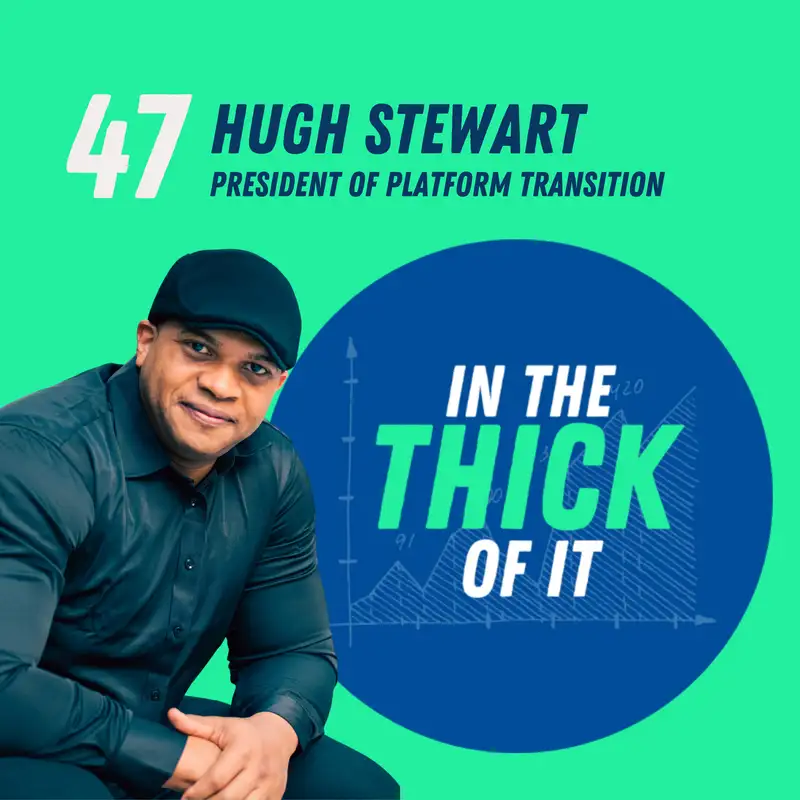
#47 Hugh Stewart, President | Platform Transition
Download MP3welcome to another episode of in the thick of it.
I am super, super excited about our guests today.
joining me is Hugh Stewart, who is the president of platform transition.
talking to him, at his, um, at his office in Florida.
And, I've been looking forward.
to this for many, many months.
and I, we've been around each other.
We've known each other in some capacity for going on 10 years now and have really had just
a really great connection more recently.
And so he's got an incredible story.
He is one of the most learned people uh you will ever hear from.
He has incredible stories of overcoming adversity.
got just the most beautiful family life.
And I'm so excited for Hugh to come on and share a story.
Hugh, thanks for making time for this.
Well, I appreciate that Scott, to your point, the reason that this has all really come to
fruition is because I have a lot to thank you for.
So what your audience may not be aware of is that Venn technology was a really curious
curiosity inspiring company 10 years ago when they would be on the floor of the expo
booths being joyful and playful and engaging.
I don't know that I actually knew what you guys did, but I just knew that you were here
and you made it okay.
And what you don't know is that I tell jokes in some of our sales calls because you
inspired one of the people that inspired
our Sage Intacct ecosystem to be joyful.
And, you know, along the way I would work with implementation specialists that would say
things like, you mean Venn technology, the guys that do the really awesome Salesforce
integrations.
And I hate when people like pigeonholed me into software because, you know, they, they'll
say things, but at the same time, that's what you guys became famous for.
it was really neat to hear that you had found a balance.
between the doing of joy and the doing of excellence.
the ability to own a reputation in the space for being competent and excellent at
execution and still make it fun.
And I can't tell you how much it is appreciated when customers get to have fun because we
get to have fun.
And so you've inspired that.
And I finally, after like seven years,
had the courage to come over and shake your hand and just tell you, you don't know me,
you've never really talked to me that much.
But what you've been up to for years has been inspiring us to take a little bit more of a
chance in being ourselves to these people that we're trying to serve.
And so we just wanna acknowledge you for your contribution to the space.
Well, I appreciate that.
That's, that's humbling and encouraging and, and, thank you.
Um, all right.
Well, we, we always like to start kind of at the beginning.
So you're, you live in Florida today.
tell us about what growing up was like for you.
So my story actually starts.
am, I was born in Jamaica and my parents, my father took me to an air show in Kingston
that was being put on by the United States military.
They had an exhibition and I think it was the Navy Blue Angels that were flying.
I remember at seven years old telling my dad,
I wanted to be an Air Force test pilot.
It was a huge part of my life.
I just became obsessed with airplanes from that day.
At 11, he managed to arrange to be recruited by an insurance company.
So he was taken from Jamaica and came to the United States and whole family emigrated so
that he could work for this insurance company.
And so I came.
And within a year and a half of being in this country, I joined the United States Air
Force Auxiliary Cadet Program and became one of the best cadets in the state of Florida,
managing to finish the program and become a cadet colonel and earn a lot of those things,
including my pilot's license by the time I was 17 before I graduated from high school, as
well as I got rated as a uh
search and rescue technician so I could go, you know, find down aircraft and save people
from, you burning airplanes and stuff.
And one of the training programs also, there's a shelter management certification that
came up as well.
And all of that helped to get me.
and I also did something called drill team, which was a cadet competition that we managed
to nationally.
And the reason I'm all of that is because that was in addition to high school.
So between that and high school, I was able to, get enough academic credit and enough
community service and other types of credit to skip a year of college.
So I
got to University of Miami and I'll tell you a story someday about how all of that didn't
exactly work out just quite right.
But you know what?
We make a lot of lemonade because there were a lot of lemons.
And effectively, University of Miami would provide enough of a scholarship in order for me
to get in.
I joined the submatriculation program.
So I changed my major from aerospace engineering because my father convinced me
that becoming a pilot had already happened before I got to college.
So I needed a fallback in the case that my eyes weren't really that great anymore and I
need glasses.
So engineering was the fallback.
They offered a submatriculation program in college.
So that way by my sophomore year, I was in grad school, also completing my undergraduate
at the same time.
And because of all the credit that I'd gotten, I was able to finish both in four years.
um And I was able to graduate with a master's degree at 21.
from the university.
I then went to go work for General Electric.
They have a subsidiary called Global Nuclear Fuel, which I got a, they have a course there
called A and B course, which is the analog to a master's degree in nuclear engineering.
So I was able to, in addition to the mechanical engineering masters and the bachelor's
from mechanical, get a master's effectively in nuclear engineering and
I worked on nuclear fuel development.
Along the way, I'd also worked at Hewlett Packard and Pratt & Whitney and Merck as a
chemical engineer.
So there's a lot of engineering.
And then I realized, oh, I didn't really like engineering that much.
I love to work.
I didn't love the job.
So I'd go into work and I remember just being in a cubicle all day.
I'd see my boss once every two days and I'd get most of my work by email.
So that was work.
And so I was like, I really liked talking to people.
So let's go learn how to sell stuff.
And so I started selling em online products over the phone just to learn how to sell
things.
Cause I was terrified of selling and ended up
joining the real estate investors association in my local city and I bought the house
across the street.
So that was across the street from the house I bought when I moved to the city.
So I became a landlord and I would end up going on to partner with the other leaders in
the woman in the real estate investors association.
I quit my job after a few years and went full time with those guys.
And we ended up buying like, I don't know, like 150 houses over like a three year period.
during that time, I also ended up partnering with one of those more specifically, and we
ended up creating like five or six other businesses and, getting into much bigger real
estate.
And then we got into a small time.
retail financial services in central North Carolina.
And it was during one of those adventures while I also owned another company in
Fayetteville that four or five employees got together and stole about a hundred and no,
it's about $200,000, $150,000.
You added it all up and you took away certain things.
They stole all of that from all three businesses.
They got robbed.
And that was when I became very interested in accounting because
If I were able to better read the reports that were coming through, would have seen that
things were not quite right.
And so I turned that opportunity into a learning.
I did my own learning.
And then I also created courses to teach other business owners how to detect fraud and how
to detect and how to learn how to read, tactically read their financial statements without
having to get an MBA.
Just how do you, what makes sense in financial statements?
would go on to operate those companies, sell a bunch of them and was left with just my
accounting staff and the building that they were in after we had a major exit event in
2012.
So I decided to start partnering with a bunch of my friends to run their businesses
operationally and do their finances.
And that's how I stumbled upon Sage Intact as an SIP partner.
We just do an operational accounting with whatever was left over.
Ended up figuring out when one of the partners, one of the businesses I ended up owning
and supporting needed its own migration from 13 instances of QuickBooks Online to Sage
Intact.
I didn't have really great data migration options 10 years ago.
So I ended up building my own platform to get it done.
And Sage Intact back then it was just Intact took a look at it and went, my gosh, if you
can do this, you can help so many other people can make it commercially available.
I said, yes.
What ended up happening was,
We ended up doing more work for other SIEPs, bringing their customers onto Sage Intact
with the migration than on ourselves.
So we ended up leaving the SIEP program and instead just became marketplace partners.
And now 10 years later, I'd like to tell you that we are the number one provider of data
migration solutions for the Sage Intact ecosystem, having done now almost 2,800 migrations
from 81 legacy systems.
That's a, that is a heck of a story.
want to, I want to go back for a minute and drill into a couple of these, these things.
you were talking about the job where you enjoyed the work, but you didn't enjoy the job.
think that's, that's how you, you frame that.
And I think that that points to a very important distinction between the actual, you know,
output that you create that creates value for the company and for, for others.
versus the experience of what it is working in that particular environment.
Does that, does that, is that a good way of kind of breaking that down?
Well, I'll go even further.
So it was also a rejection of the values.
So here was a, here was an exercise.
I was 22 when in the program that I was involved with when I worked for GE, we had this.
I rotated into a role where I was put as a project lead for what was called a bid
proposal.
It was a bid proposal for a.
nuclear power plant in another country.
I won't be able to say which one.
And this nuclear power plant was like a $2 billion build.
And our piece was $185 million proposal.
Okay.
It's a big deal.
I was put in charge of coordinating the activities of three teams in three countries.
So I was in Wilmington, North Carolina, and I had the
the team that was helping to build all of the technical specs and all the responses.
And then there was a team in France and a team in Japan.
And basically I had to collect information from all three of them, assemble it.
It was a 4,000 page proposal.
We got it all put together.
People worked tirelessly and we calculated a margin on that $185,000 to be, I'm sorry,
$185 million to be like.
I don't know some crazy number like 70 % margin.
So this was money like real money and this was 20 something years ago.
When we got the bid won, I petitioned for the 22 people that were on the team to get
$1,500 bonuses.
Because again, people worked over the weekends, they like sacrificed, we really pulled it
together and got it in on time and it was an excellent exercise.
The response from the management was no.
They gave me a $750 gift certificate and I think my boss got like a $200 gift card.
And I was like, well, wait a second.
Like if I can sit here with my 22 year old self and build value of like $150 million for a
company on a single project, maybe I can do 1 % of that for myself.
And when I own a company, I'm not going to bat an eye at if someone brings me value or
creates value proactively in my business.
You better believe I'm going to do everything to share.
Love that.
just from a value standpoint.
So one of the things I'm proud of is that our company, all of, doesn't matter if you're a
contractor or if you're a, an employee, if you belong to our core production team, you
participate in 10 % of the profits of the business, no matter what.
So 10 % of everything we net,
goes back to our employees.
And you don't even have to be employed by us to be able to qualify for the program.
Because if you create value with us, you should participate in that value in some
meaningful and unencumbered way.
Well, and that creates alignment of incentives, right?
You know, when the company does well, we all do well.
And I think there's just a ton of wisdom in that.
Man, you have done a lot of interesting stuff.
Nuclear engineering, chemical engineering, is there much overlap in that or?
absolutely.
Well, same foundational principles, right?
So I was a fluids expert in college.
So my thesis was on oil spill reclamation and I was published, I don't know, 2001 for my
work on oil boom reclamation technology.
Waves, you can design certain booms so that they collect oil to clean up the environment.
Those principles.
They follow you everywhere.
So if you're a chemical engineer, you still need the flow of mechanics.
And the work I did at Merck was on their barrier operations division.
This is where they filled vials with what's called sterile diluent.
mean, this is the stuff that you reconstitute vaccines.
Well, back then they had an avant-garde process to fill these vials with no human
interaction.
So the ability for human being to contaminate an environment was reduced.
The same principles that you learn in oil spill boom technology is the same principles
that you would apply to the fluid mechanics that require filling vials.
I had the pleasure of working on the JSF119 engine when I worked for Pratt & Whitney.
This was the engine that would go on to buff.
to be outfitted for the YF-22 when it was the YF-22 before it was the Raptor.
So being able to get involved in that and understand the fluid mechanics in the engine as
it processed and we did modeling for heat transfer in the engine profile for that job.
And for HP, that was the first place I ever got a patent.
So if you look at HP invention disclosure,
HP has the patent.
Let me be very precise.
So the invention disclosure was after a few months of research, we were able to create an
error correction and quality assurance process that made the swath.
What's a what am I swath when a printer prints on a piece of paper, it deposits ink in a
in a line.
And so the way it crosses the paper.
deposits a certain amount of And then when it crosses back, there's a perfect rotation of
the spool so that the paper advances ever so much so that when you run it again, you don't
waste and you don't overpopulate the ink.
And then you switch and you swap it again.
At one point, I had like 40 different printers in my office and I was testing all of them
algorithmically at the same time.
And again, this is like in 2000, this is 25 years ago.
And so the process to think through, how do you conduct a test with 40 different printers
at the same time, all incrementally capturing data so that at the end of the day, what
came out of it is if you have an HP printer today, you have a setting called fast draft.
Fast draft was my baby.
You know, when, when they finally released it, they actually sent me a check for
the contributions that I had made to FastDraft.
It was my favorite job ever, was working for HP.
That was the coolest thing since sliced.
I will never, I moved to Vancouver, Washington to go work for that company and it was
cool.
um Anyway.
interesting contrast to the other company where they didn't want to bonus out and yet this
company proactively saw your contribution and rewarded you for it.
And retroactively, so what happened was I left HP because I worked there only for uh a
summer.
And after my research there and I'd gone back to regular school, that's when they sent the
check after the invention disclosure.
So it was very powerful to appreciate the different cultures of who I wanted to be when I
started my own company.
And I'd worked in enough places that I could piece together the ethos that I wanted when
that was time.
I also had a very, very instrumental mentor that started a conversation with me when I was
15.
And I think, well, I tell you the last time we talked was probably three years ago.
So he has been effectively talking to me for 30 years.
And he was instrumental in telling me, you know, I've sent three of me, this is him
talking.
I've sent three of my children to the military.
I don't think.
that active duty military works for you.
Cause that was my dream.
wanted to be a test pilot, that enough, you know, wanted to serve.
I ended up doing it through the air force auxiliary.
And so it was very, very wonderful to be able to end my service with the air force
auxiliary in 2014 as a major.
And now that chapter of my life is behind me, but it was really wonderful to spend 20
years doing that still flying, still supporting kids, still doing that stuff.
But
Being a taxpayer, creating businesses, creating value with a bunch of friends.
He told me when I was 15, no, when I was 17 and I was thinking about going to college, he
said, what I see you doing well is creating value.
And then when I was 19 and no, when I was 20 and about to graduate from grad school, he
said to me, yes.
start by getting a job, but recognize that the best value that you can contribute is
finding a bunch of friends and tearing some economic holes in some big problems that you
find out in the world.
That's what he told me.
And I didn't know it at the time, but he's one of the richest people that I even didn't
know that he was wealthy.
He just would advise me.
And then I went to his house for the first time and it was 15,000 square feet.
And I was like, oh God.
And he said, yeah, let's take a tour.
And when we walked down the main street of his city, he would just kind of point to
things.
And he was pointing and talking about things.
then when I later really understood what was happening, he was showing me all the
buildings that he owned on that street, which was the main street of the city that he
lives in.
And so it was like, okay, somebody who is this accomplished is seeing something in me and
is saying that based on how I show up to the world, he wouldn't even make the same
decisions.
for me that he made for his own sons who he sent to the military to go serve in Iraq and
do other things.
Instead, he sees me as being someone who should lead in corporate America.
Fine.
Let's see where this goes.
What are your thoughts?
Well, so mentorship is one of my favorite topics and it's something we've talked about on
countless episodes.
Was this something that you sought out or was this somebody that found you and found
somebody that they thought they wanted to invest in?
Because I'm here and he's not, we're going to tell my version of the story.
So he was in the Air Force world.
So when I was a cadet, he was one of the cadet adult leaders.
He was a previous Marine Corps captain that had now found himself in the Air Force
auxiliary as a major.
Very famous in our circles.
And we were at a conference.
I was 15 years old and I decided I really wanted to know him.
And so he was sitting at lunch and I just sat down in the booth across from him and just
started asking questions.
And at first I think he was just kind of annoyed.
And then, and then I think there must've been something that I said that made him find me
relatively interesting.
And then the conversation just never stopped.
So he was there when I was determining how to graduate from high school.
He was there when I got into grad school.
He was there when I was graduating from grad school, kind of whispering in my ear what was
next.
When I was starting my first company, when I failed the first time, he said, you know,
you're probably gonna go bankrupt three times in your career, just be ready.
You'll know when.
Just know, this is just what happens.
You're gonna have an event where you're going to leverage more than you should have.
probably made the right choice anyway, see it through.
Stuff like that.
You know, who's going to whisper that stuff to you from on high?
Man, I love that.
And one of the things I've experienced personally, and one the things I've talked about a
lot is that mentorship can be formal and it can also be informal.
And just for people listening, I cannot encourage you enough.
If you don't have mentors in your life, formal or informal, find somebody to mentor.
And whether that's a coach, a business type coach, whether that's
people in the circles that are in and around your industry, find somebody that's a little
bit ahead of you and seek them out.
And you'll be surprised how many people are actually willing to give you their time and
their knowledge and not unlike what we're doing here today.
so having other people that can see around corners that have walked the roads that you're
going to walk.
There's so much value.
Yes.
without a doubt.
that's a big part of the spirit behind this podcast is we want to inspire and encourage
current and future entrepreneurs.
want to tell the stories of our trials and our triumphs so that you're going to make your
own mistakes, but don't make the mistakes that we've made.
Or when you do, just know that you remembered him saying something about this.
Well, and I've got plenty of those stories of people, you know, warn me about things and I
clutch the hot stove anyway.
Well, so you, you had this horrible experience.
You had people steal from you that, kind of set you on this, this path talk.
Um, actually real quick, one of the things just for, people that aren't familiar with
Intacct and what is an S I A P and a marketplace partner, maybe, maybe talk just a little
bit about those, those things real quick to give context for kind of this next, section.
Sure.
So to skip to the end of the story, we were a, call ourselves an operational bookkeeping
and accounting firm.
So I had a number of CPAs that worked for me.
And what we would do is we would, and it started with my friends.
Basically I would help my friends who had interesting businesses, but hated bookkeeping
and hating financial accounting.
And I was their fractional CFO.
Effectively, I would take a look, analyze, you know,
their sales, their revenue, their expenses.
would help produce reports.
would give them, know, insights on the use of their cashflow, if they had inventory, if
they didn't have any, all that stuff.
And so effectively when we became aware of Sage Intact, when we were living, leaving the
QuickBooks online universe behind, we were doing our bookkeeping on QuickBooks and for one
particular customer.
we needed to find something else because Sage, well, we were on 13 instances of QuickBooks
and that was driving everybody bananas.
13 different logins, 13 different sets of, it was taking one of my employees 35 hours a
month just to reconcile the inter-company transactions.
the company A doing business with company B lending money, because we never had money in
the right place.
All the,
The funds were in company A, but we needed them in company E.
So in order for that to happen, you need to create a loan from company E to company A and
company A has to register that loan to company E and the transactions have to be properly
recorded in both sets of books for all of it to work.
One person's job, that's all they did.
Well, almost all they did for that particular business.
When we found Intacct, Intacct has the capability
for automated inter-company entries.
So with one click, you can do all of the transaction entering in both sets of books
because you just set it up right.
So Intac was a no-brainer for us.
Getting into it was a different story.
So when we found out about Intacct, we found out about the different programs that we as
an operational bookkeeping company could enroll in.
to offer our clients access to Intacct in addition to our own subscription.
And that is called the SAI, now it's SIAP, it used to just be IAP, is the Intacct
Accountant Program, or the Sage Intacct Accountant Program is what SIAP stands for.
After a few years of dealing with that, and when our migration solution became more
mature, we became MPPs, or what are called Marketplace Partners, which you and I are.
in the environment.
Is that what you wanted me to clarify, Scott?
marketplace partners provide ancillary solutions on top of the core accounting product
that, you know, extend the capabilities and provide additional value to the end customers
that are using the core product.
So let's talk a little bit more about platform transition and what you do.
And for people who have never
experienced a system conversion of sorts, whether that's a CRM or an accounting product,
there's a lot that goes into it.
There's the initial design and setup of that core system.
There's the training that goes into getting people up to speed so that they can run with
the tool effectively.
But
data migration, getting your data out of the legacy system and into the new system.
it is a hairy, painful process.
And it's also one of, if not the most critical components to these projects being
successful.
You can't just, unless you're a brand new company and you're rolling out the system for
the first time, you have to have your historical data brought over.
You're not going to
hand key that you're not going to, you know, start from zero.
And so what, what Hugh and his team does is they solve this, this, this problem and pretty
much any, anybody that's helping implement any software system, there's going to be some
amount of data migration, but you do something very unique and very different from what
most do.
So talk a little bit about what makes
platform transition different from just any old data migration.
Sure, thank you for that intro on the topic.
we would tell you that our focus, well, what I've come to appreciate is that the word data
migration means very different things to a lot of different people.
Where...
We have we have nine different scopes, so there are different things that we do to support
what could be considered data migration.
If you were asking what I do for a living, I would tell you in its most poetic form.
We rebuild history.
So there is a significant.
Subset of customers.
That absolutely want confidence in the fact that.
They want to be able to move to the new system, the newly implemented system, and not feel
like they have left anything meaningful behind.
They will range from being able to want to do transactional detail reporting on things
that happened 12 years ago in detail.
Or my favorite is where they will want to
They will have the limitations of a legacy system.
So they'll be in QuickBooks.
They'll have 95 QuickBooks files because they're a family office.
And they want to be able to see every single transaction that they have ever done in any
company recast with things they wished they could have seen.
So we rebuild departments that never existed from history.
So they can report in ways they are now
aware that they would want to know, but they didn't have it back then.
So during the process, able to, we're able to rebuild history and present it in ways that
are now in line with the capabilities of the go forward architecture.
the other thing that is really fun is when we do this at scale and we get asked to do some
of our hardest scopes.
The fun ones are where we can rebuild history to make it look like you were never on
anything else.
So someone will have, we just did this one recently.
Someone will have 15 years of history in a QuickBooks file and we will rebuild their sales
orders, the purchase orders, their converted invoices, all the payments, the GL, make it
all post and we'll bring over their attachments and attach them to every transaction that
has ever happened.
So you look in Intacct and you could not tell that there was ever a QuickBooks.
And for some of our folks that want to sell their companies to other people, this
rebuilding of the history is a very compelling opportunity for them to get a higher
multiple because they have really clean books that always existed exactly with visibility
into things that they didn't even know that they could have tracked when they did it 10
years ago.
Two things I want to drill in on and for people that hear like rebuilding history and
rebuilding it in ways that it didn't exist before, this is all on the up and up.
This isn't Enron, you know, fabricating things.
This is, you've got limitations in lower end products that don't give you the granularity
that you get in more powerful products.
so being able to go and logically,
tie things to, you know, as you said, a department that didn't exist in the previous
system, there's tremendous value.
So rebuilding history, but with detail that you just couldn't get before.
The other...
case in point.
I'll give you a case in point just to illustrate that point.
We had a customer that didn't have the capacity to track projects in their legacy system.
So they would put this project ID in the memo line of their transactions and it was SDJ
and a 10 digit code.
So we have an algorithm that we call it memo scraping.
We will read every single line of a transaction and every single transaction.
And we will look for SDJ and 10 digits and bring that out so that a project can now be
tracked at scale for anything that has a unique SDJ blah, blah, blah code.
And that can now be amalgamated and tracked and reported on historically where it was
never able to be seen before.
continue.
the value of that there, when you're dealing with just text strings, there's only so much
you can do and you have the potential for human error with that and so forth.
And if the reporting tool doesn't have the ability to take that into account and parse
that out and represent it in a way, you lose so much visibility into things.
so what they do is truly revolutionary.
The other thing that I think I want to...
draw attention to, you talk about the amount of detail that you bring over and down to the
transaction.
A lot of times what happens with data migrations is A, they typically only bring say two
years worth of history over and B, oftentimes it's summarized.
It's not at the transaction level.
And what I don't think it's a stretch to say that if somebody wanted to pull up a, an
invoice from
22 years ago in whatever system they were using and they want to know the check number on
the, the, the check that was received for the payment.
Like you've got the ability to get down to that level of detail.
And that is truly a game changer for a CFO.
you know, operating many years down the road.
And to add to that, we can also bring in the attachment that's associated with the
transaction historically.
So you don't have to go anywhere else, we get that request a lot because folks, well, two
things have become very popular.
People have stopped printing paper.
So there's no hard copy of the file anymore that went along with that transaction.
And a lot of folks like that scope because it helps them survive audits.
So if there's an auditor that wants to look at a particular
invoice or bill that was paid by a particular payment and they want to see the attachment
that went along with that bill to prove that they really received that bill, all of that
is oftentimes a part of the standard subledger migration rebuild scope.
I know the answer to this, but I'm going ask the question anyway.
Do you consider yourself a detail oriented person?
What?
No, no, sir.
As a matter of fact, I've been tested.
So one of the things that happens when we hire, we've used a cognitive skill testing
service called Kolbe, KOLBE, for the last 25 years or so.
They...
have amazing, amazing profiles that help us design every single role that we have in the
company.
And everybody's numbers are posted so you know who you're likely to fight with and where
empathy is necessary because this person's job is not to piss you off.
This person is just being themselves.
Their numbers just have enough variance from you or difference from you such that
The rule is any difference in the profile number of four or more will lead to conflict.
So you kind of know that ahead of time.
are, they're oriented to come at you a certain way because this is what they need to live
into what they define a success.
That's the whole idea behind cognitive skills.
It's not a personality test.
It's just how do you assemble the world around you to succeed at stuff?
And some people, the first number, we're going to focus there because I don't want to bore
the crap out of your audience.
but the first number is all about fact finding, which is akin to detail orientation.
My number is a four, means I am barely resistant to details.
I can't handle them.
Like if you give me detail without my having a purpose for it, I literally will begin to
grow out and want to put my head through a window.
However,
Because I'm not detail oriented doesn't mean I don't care about details.
That's not the thing.
And so my, my CFO, my COO has been really, really good at being identified, able to
identify the other numbers.
So the, the second number is about systems.
The third number is about flexibility in, we call it quick start, but basically it's how
do you quickly or, innovatively respond to a situation or do you defend the process as it
is?
And both are necessary depending on the role.
I happen to be a 4772, which means I lead solving problems by creating systems and taking
innovative action.
And I'm resistant and retardent to a lot of detail.
However, if I am creating a system, I care deeply about the accuracy and the assurance of
quality on said results from the system.
So if I have a system that's never to lose a penny, I'm going to be looking for every
single penny.
not because I care about the detail, but I care about the fidelity of the system.
Does that make sense?
Yeah, that makes a lot of sense.
So I'm fascinated to hear that you're not, you're not personally detail oriented given
other conversations we've had and, talking about the detail that goes into these, these
data migrations that, just, yeah.
the system has to deliver perfect results.
So the data being detailed is a function of the result of the process.
Not because I personally can withstand.
I will look for pennies.
We have spent weeks looking for a quarter if we have to, but that's in service of the
system.
Fixation I'm almost fixated on systems.
That's a part portion of the system's fixation.
It's not because the detail itself is what makes me happy.
If it's detail without context and if it's detail not in service of the system, I can't
bring myself to care about it.
So talking about systems, you've developed this methodology and tools to do these complex
migrations and going back to you were providing these outsourced accounting services for
these companies that led you down the path to move them to this new accounting system that
was a lot more powerful.
Talk me through the
the mental shift and the mindset to go, Hey, I think I want to get out of this outsourced
accounting business.
And I want to completely revamp my business around data migration.
what sparked that?
Was there a moment?
What triggered that?
little bit of terror, a lot of fear and a lot of failure.
May I, may I, you interested?
Is that, is that intriguing?
Uh, so we, we lived in two worlds when we kind of spearheaded the migration.
capability where.
In the Intacct account and program.
We were helping SI other SI AP partners.
Put.
Vast numbers of people onto their portals.
And we were so focused on that that we never actually stopped to put anybody on our own
portal, because we're making more money migrating data than we were making money doing
other people's books, and they're two very different models.
You know you're either you're either doing it's.
almost akin to the implementation through a VAR, like the value added resellers will have
implementation specialists and a lot of them are accountants actually, but the
implementation work is very different from the accounting work.
In the same vein, data migration work is very different than ongoing bookkeeping work.
And what we realized is at one point they started instituting quotas for
business development on SIAP partners.
So in one room, we would go in and we would be hailed as the SIAP savior because we were
there to support all of the Intacct account partners that needed help getting folks to
migrate to Intacct from QuickBooks or whatever they were on.
But then in another room, we were at the bottom tier for all the people that didn't build
their businesses well enough.
So we were failing badly.
So at some point we're like, well, wait a second.
The other part of it too was there was some trivial, non-trivial number of IAP partners
that would look at us and say, hey, wait a second, you're an IAP as well.
You could steal my customer.
And we wanted to be in a position to not have any opportunity for conflict of interest.
at one point we're like, we're crushing it with this migration opportunity.
We're not really focused on building our portal with more customers to do their books.
And we have this image problem where other IAPs might be thinking that we're going to
steal their business because we carry the same designation, even though there's no chance
because we don't even want to do that work.
It made sense, I think in 2017 to just go, you know what?
Let's make the jump.
Let's just get certified in the marketplace.
And just for your awareness,
We are one of the only marketplace partners that doesn't have an integration because we
don't fit anywhere in the system.
But Intact was the first.
So I don't know this ancient history, but Sage Intact back in 2015 made the call to put us
on their paper before you were marketplace partners.
So you could have optional data migration services offered by our previous, the first
version of our company, which was called financial co-pilot.
That's what we used to be.
And what ended up happening was working with them became too cumbersome because of other
reasons.
However, they allowed us to go onto the marketplace because there was no other program
that could fit us.
And we were accepted.
We dropped the IAP designation because it just didn't make sense anymore.
And we basically showed up in a world where we didn't quite fit, but people couldn't quite
move on without us because we would be the solution.
to help folks get sales, to have VARs get sales, have Intacct itself get sales, because a
lot of people would say yes if they knew that their data was gonna have a really awesome
experience coming over and being there when they started up using Intacct going full.
One of the things that I love about doing this is hearing people's stories, how over the
course of time, for very few people, it's like, yeah, I just did this thing and off we go.
There's a progression of one thing leads to another that leads to another that leads to
where you're at.
And
I'm guessing that in the midst of that moment, when you realize that these people were
stealing money from you in that moment, is it a fair, fair thing to say that it never
crossed your mind that a decade later or however many years later that you would have a
business doing complex data migrations?
Oh my gosh, in sales calls, tell a terrible joke.
I say, given everything that had happened and where we started, if you would have told me
that 10 years later, I would be making 95 % of the money that I make in my life from doing
migration work, I would want to have whatever you're drinking because clearly it's strong
enough.
That's the joke I tell in sales calls.
because this was not in the cards.
what, so the other thing I don't know that I shared with you Scott is that this is 2025.
I've started 37 companies in 25 years.
Okay.
And what's neat about this one is this one's lasted 12 years so far.
So a lot of the innovative,
multi-company starts are kind of behind me.
I don't really do that much anymore, but now the innovation is just concentrating itself
into these different pockets.
And what I've learned is
You really don't know what's gonna work.
You have a number of operating principles that guide you to how you make decisions.
I have a few.
I'm gonna tell the truth.
I'm gonna show up on time.
I'm gonna finish what I start.
I'm gonna say please and thank you.
I'm not gonna take things personally.
I am going to do my best and I'm gonna be impeccable with my work.
Those are the principles that we operate by.
If those things are true, and I live into the five core values that we say at our meetings
every Tuesday, then whatever comes, we land on our feet.
We serve people, we do work that's valuable, we don't find ourselves in deals that we
shouldn't be in.
We don't get greedy, we charge what we should, we give what we can.
We create more than we consume.
And we teach where we can.
Being the intellectual thought, being a thought leader in the space now has become more
important because it's important now for me that I don't care people use us, I care that
they do the work right.
Because if they do the work right, the appetite will exist and they will come across a
deal they can't do and they will call when the time is right.
There is enough and there's enough for all of us.
And so...
It's important for us to be out there contributing, helping, guiding, teaching wherever we
can.
And the story is going to unfold how it unfolds.
have, I post and create trajectories and plans in our EOS plan planner.
have our BTO like everybody else does.
And I have my 10 year plan and I'm telling you all the things that are going to happen.
And I have to speak with confidence, but deep down, I know this is this.
This direction is so that we have a direction, but we're not married to the direction.
We're married to our spouses, right?
So you understand that.
Yeah, got it.
We have to speak with confidence, but we are very clear that we have no idea what's about
to happen next.
And that's okay because we're operating from a place of abundance, of kindness, of
generosity, of care.
We care about our customers.
We care about the outcomes.
We care about being where we need to be.
And if we get wiped out.
it will be for all the right reasons.
You talk about that abundance mentality and that is something that I think is just so
incredibly important.
on the space that a business operates in, your competitors may or may not be friendly.
And one of the things I love about the ecosystems that we're both a part of is, yeah,
there's competition, but generally speaking, with few exceptions.
People are generally willing to help their, their competitors in different ways.
And I've, I've heard stories of partners actually getting on an airplane to go and do a
demo for a client or for a prospect for a deal that they weren't going to win.
And, and, and they just, they help each other out, but you can't do that if you have a
scarcity mentality.
Um, a couple of weeks ago, I was, I was on a call with a, with a, another partner that we,
we compete directly with and
we don't run into each other in deals all that often.
Occasionally we do.
And you know what?
He's going to win some, I'm going to win some.
But to your point, like there's enough business to go around.
And when I talk to other owners and they talk about the competitive space that they work
in and you know, they've got this just, you know, deep seated rivalry with XYZ.
And I just hate that.
I think that business would be a lot.
better if we all just had that abundance mentality.
There's plenty to go around.
There's no way any like one party can serve the entire market.
And so let's go be good at what we're good at.
Let's, let's conduct ourselves with character and let's help each other out.
Well, I will tell you that there's a part of me that has taken that to its logical
conclusion.
So.
the only real competitor I have is customer apathy.
Them not doing anything is the only thing I'm competing against.
And I'll give you an example.
So I'm not going to use real names, but you can figure out who these people are when I
tell you who they are.
There is a scope for a legacy system that we have just not been able to do for years.
I don't get many requests for it, so I never really spent the money to develop it.
Sage 50, Sage 50 US has.
It's tough to do a subledger migration for that for that legacy system.
It's just tough, cause it's tough to get at the data.
We have a competitor that's really good.
They've got technology that can get at that data.
And recently we had a we had a government entity come to us and say.
We want this and we will not say yes, unless it is a subledger migration from Sage 50.
And so I believe that if I can buy or borrow or lease or rent, then the world is mine.
And if I am in service to the customer and we can all afford that which it takes to get us
to the result for the customer.
then I am empowered to buy whatever I need to get the customer's answer resolved.
Because we finally had somebody that was willing to commit to the entire cost of getting
the subledger migration done from Sage 50.
So I called up the competitor and I said, hey, you have better technology than we do for
this scope.
We migrate 81 legacy systems.
I'm not gonna be bothered to learn every single one.
I don't need to, but what I do need
is the capability that you guys have for this one part of the process.
Are you willing to play with us and get us what we need to get it?
And they're like, sure, send it us our way.
We're ready to do this.
This is what it's going to cost.
We're happy to do work with you.
And we've been talking for years about exploring this.
I told them, anytime I actually get somebody to come into scope, I will come to you.
And so these are supposed to be people that are supposed to go head to head with us.
And you know what's been great over the years?
I've sent them business because customers have come to us and they said, we want this and
they're just not the right customers for us.
And you said, you know what would be great.
Go over to those guys because they are more in line with what you're after and they're
better at it and the charge you less.
Why spend extra money if you're going to spend too much with us?
I don't want to be involved in a deal where my value is not absolutely clear.
Just, just not going to do that.
So anyway, getting back to the story at hand.
Ended up calling them, they were thrilled.
We signed a deal and now there are subcontractor for providing data support services to
this particular customer who has the Sage 50 subledger migration.
And it has been a successful experience that we will do again if we get another one,
because what they've managed to show us is we don't want to go develop this tech ourselves
if we don't have to.
don't have to, because they can deliver it at a much better cost and they already have the
technology hanging around.
So if we would have been greedy about it, we would have either said, no, can't be done.
So Sage and Tech wouldn't have gotten the deal.
Or we would have tried to take it on ourselves and done a horrible job doing something new
with a very large organization that we don't have any business messing this up for.
So instead, our competitor ends up making money exactly what they wanted to get to charge
for the service they got.
We were able to get the deal and the customer is able to get the scope that they want.
And Sage Intacct now has a happy customer before they even go live.
What are your thoughts?
Again, man, I think that's just a beautiful example of the abundance mentality.
I think part of the abundance mentality also means you have to know what to say no to.
that's an example of, you had to work to find a way to say yes.
And it was something that made total sense.
But I also think about your story about how you kind of had to
you came to a fork in the road with the outsourced accounting practice and your platform,
you you had to say no to this other thing that you'd been doing.
And I got to believe that if I was you, that there would have been temptation.
Wow, there's revenue there.
And, and so I guess kind of framing out the next question, how do you decide what to say
yes to and what to say no to?
That's a very good question and I don't know that I have a great answer.
Maybe I still have a good one.
We'll find out.
What's beautiful about my life is that I have I have retired twice at this point once in
2005 when we were able to go to to New Zealand and just live there for a month just go and
be away and then came back and dead did things and then in 2012 when we when we sold
our series of companies in North Carolina and we were able to come back to live in
Florida.
So it's been amazing to look at the bank account and just not be able to spend everything
in the next two or three years.
And then we've also been in a place where I don't know how I'm going to make payroll on
Friday and it's Wednesday.
I don't know.
I, I remember one of the scariest moments of my life is I remember we had an $80,000 a
month burn in one of our companies and as two weeks into the month,
And my investor, my last investor said, I only have $40,000 to give you.
I can't afford it.
And I didn't know where the other $40,000 was gonna come from to get by in the month.
And so when you've gotten to certain places that look like success and you have
effectively, and I've had some situations where you could make the case that we had lost
everything.
mean, the theft, you you're already losing $80,000 a month and then somebody steals
another $150,000 from you.
It takes you down.
Like you begin to feel like you're, I know the big mistake I made at the time was my
self-worth was equal to my net worth.
And so all of that was in the tank and my confidence was completely shot.
And what I've learned is that your capacity to be an effective entrepreneur has everything
to do with confidence, not an aorta of what's in your bank account.
Cause you could have a million dollars in your bank account and you could suck or you
could have nothing, but you know what's going to happen next.
you know, the future just is.
a story unfolding.
I have not forgotten your question.
I'm answering it, but I'm answering it from the framework of, okay, if you understand that
being absolutely successful is not going to save you because there's always more and being
absolutely destroyed is not going to truly destroy you.
Remember, I used to say to myself, if I can draw breath, I can solve this.
With my next breath, I will take one more step because sometimes it's all you have is one
more step, but one more step is still one more step.
You recognize there is no Mecca and there is no true hell.
All of it gives you the ability to build character and move forward.
That being said, the next idea is the idea of the committed framework.
What I realized...
is a confused mind weighs options.
So a clear mind only sees one option.
So the way you do that, and it's sad, and it's gonna sound a little flippant, but I
promise you it works.
Pick something.
Doesn't matter what that something is, but just pick something.
and then reorient all action and all decision making around whether or not that something
is achieved or that something is delayed.
Yes or no.
And that makes life very effective, very efficient, and it makes you a better decision
maker.
but you gotta pick.
Go ahead.
love that you mentioned Colby.
We use something internally called culture index and my profile, I have what they call an
AD conflict and I'm I'm not going to attempt to try to break that down.
And as an aside, I've said this before too, I used to think that these profiles were just
total BS, total garbage.
And as I've gotten older and hopefully a little bit wiser, I've actually come to see that
there is tremendous value.
And you talked about how these tests kind of help manage the relationships with the people
within the team.
But I also think that there is tremendous value in knowing yourself first and creating
that self-awareness.
So I have this AD conflict and I didn't realize that
the output of that is sometimes, oftentimes I struggle to make a decision and, I get into
that analysis paralysis and having gone through the process with culture index, I now have
that self discovery.
have that self awareness and it has helped me in these situations.
Just honing it on your point.
Oftentimes inaction is worse than a
making the wrong decision.
And to your point, look, it's A or B, pick one.
Okay.
Yeah.
Wait, wait, pros and cons, but pick one.
Don't just sit in limbo and kick the can and kick the can and kick the can.
You have to act and you're going to lose more, more often than not by not taking action.
And let's go even further than that if you'll allow it.
pick one and make it right.
So often I joke about this, but it's only half a joke, right?
You got two choices and it's really the same choice.
You're either going to pick the right choice or you're gonna pick a choice and make it
right.
That's it.
And the beautiful thing about cars is if you pick a direction and you drive in said
direction and it's not the right direction, you turn the wheel.
But you picked a direction because if you're sitting there and you're not going anywhere,
you're turning the wheel.
None of that matters.
And you're going to get hit by something, right?
If we're going to take the analogy to where it goes.
So the, the, the, the, understanding is.
And, but that's a four seven, seven, two talking because again, I don't need to do a bunch
of research to know, to take action, because remember my second seven is all about
decision-making.
So I have no challenge making a decision and then seeing whether or not it worked out.
but I'm always moving and always trying stuff and getting my butt kicked.
I get my butt kicked a lot.
There's a lot of failure.
You don't come through this and you don't become one of the best providers in the world at
what we do without having your butt kicked sometimes for years.
And yet the ability to learn, to recognize, do significant pattern recognition and then
adjust.
It's not just the act and, you know, choose an act.
Choose, act, respond, analyze, determine whether or not it's working and then have sensory
acuity and then just keep refining.
And you will find a direction that is supposed to work for you.
Does that resonate?
What are your thoughts?
without a doubt.
And kind of on that note, where that kind of takes my mind to is how different through
that, you know, pattern recognition and iteration, how different is your business today
than it was 12 years ago?
my gosh.
We are the same and yet we are.
I don't even I don't even recognize us sometimes.
So when we got started.
It was just me.
I was doing the coding.
I was doing the calls.
I was doing the contracts, you know.
We were fast.
But.
But it was it was limited to just me and then we hired.
one more person, my wife came on board, she was also a project manager.
People like me, they loved her.
She was more detail oriented than I was.
That is something that's pretty funny.
But what's neat is we both compliment each other.
So our numbers are almost mirrored.
So we're built for conflict, but if we actually get on the same plan, nothing slips
through, right?
So that was interesting.
In the first two or three years,
And today we have a sales division that has initiatives.
What the heck?
I have a company that has initiatives.
Initiatives used to be BS that GE would do and they would like shake pom poms and people
would just spout nonsense and they would get up in front of people and talk about things.
But I have initiatives where we say things like we are going to reduce the amount of time
that this process takes by 40%.
It will take
four days for this thing to happen instead of 10.
And that is a measurable outcome that you can put a number to and you can say it to a
customer and their $200 million business will be able to operate that much faster because
you're two days earlier.
Real stuff that we are able to see the outcome.
And it's beautiful to have at this point.
I think we are up to maybe 20.
20 testimonials on our YouTube channel where people are saying these things and it's like,
my gosh, that's right.
That's why we do this is because, you know, I tell you, we didn't post this on YouTube,
but this one was, it came across my desk from a testimonial exit interview where the lady
said, great, now I don't have to commit suicide.
Was she serious?
Who says that completely jokingly?
And it was like, okay, we're doing something out here, right?
Where people are truly, there was one that made my year.
She said, I can spend Christmas with my family now because I don't have to do this.
And it's like, okay, this is why we have purpose.
We have systems now that manufacture that experience at scale where it was, you know, once
upon a time it was, Hey, there's this guy that knows how to do data migration.
that was 10 years ago.
Now it's, hey, there's this company that
doesn't have happy customers, they have raving fans.
People whose number one complaint in our exit interview is, why weren't you introduced to
us earlier?
And you know you're doing something right at scale when you're hearing that across 30
customers in a quarter.
And that's the difference with how our company is run.
The ethos is the same, but our
ability to deliver sustained consistent results is where it's becoming really fun.
And I don't know why I'm going fuzzy again, but here we
You talked about being that one man shop and our beginnings were very, similar.
I know the angst that I went through in getting to the point where I finally said, okay, I
need to start hiring.
I need to start growing.
It can't just be me.
Talk to me about that experience for you bringing on those first few hires.
Hmm.
Okay.
was kind of easy because I was failing.
I'll tell you, when we were starting, would craft, it was a single migration would be, and
there are some innovative things we figured out how to do for migrations to make them
perfect the first time.
That's the whole point of the exercise for us.
Because we're flat fee, we don't get to charge hourly.
We don't get to be paid for our mistakes.
We get to do it right within this framework.
And if we get it right, then we make margin.
If we get it even better, right, we make more margin, right?
If we screw it up, then we have a lot to learn because we get hurt again.
Well, we were always flat fee from day one, never charged hourly for our core service.
So when it was just me, a migration was...
I'd get the extract or I'd go into QuickBooks, get the data out.
I would do an analysis and then I would build their vendors, customers and employee
templates from scratch.
And I'd have to build every single field that worked when we had onesies and twosies.
I got the first five file migration and I was like, my God, it's going to take, was taking
on average 10 hours per file to build.
these maps and template packages for each of these files.
And so my dad at the time was messing around.
He's like, you know, I've got, I'm, he was in a foreign country building on health
insurance division for a company is what he's good at.
And he's like, you know, I started playing in this program called access.
I bet you that I could help you build.
these map and template.
packages with access.
And I said, you know what, take a stab at it.
Cause I am dying here.
I'm working Friday nights and Saturdays and Sundays, trying to pull these things together.
And there's gotta be a faster way to do this.
Well, within five months, he built something called the RMTG, the rapid map and template
generator.
Would you believe that we are on version 40 of the RMTG and what took me 10 hours now
takes
seven minutes in that software.
So he came on board working for me part time, my dad, who, and this is a really powerful
story.
I was still in Jamaica, traveling to this country on vacation in 1985.
And we went to a truck stop right outside Orlando.
And, you know, I don't know if you ever heard seen these, but there's a
kind of a business card machine used to put a dollar in it.
This shows on those old man stories.
When I was young, man, a dollar blah, blah, Well, you put a dollar into the machine and it
would spit out a business card for you.
And it was Stuart and son.
He basically put the dollar in and he built a business card that was Stuart and son, Inc.
And it was amazing that 30 years later,
He's coming and he's being my first hire outside my wife, helping me in the business.
And he's helping me to, you know, we charged a couple thousand dollars because that was 10
hours worth of work for this map and template package.
And it just got better and better and better and better.
And he just never stopped working on it.
So it's been going now for almost 10 years.
And now it's at a place where we can do a map and template package for a hundred
companies.
in about 45 minutes.
Wow.
And just, just think about that as a game.
And then I was having trouble extracting data from certain systems because it was taking
too long.
And I re I realized my cousin Xavier was, you know, working for his, his father-in-law,
like stripping floors or something.
And I was like, dude, do you like working on the floor or could you just come hang out
with me?
I'll pay you whatever my, know, your father-in-law is paying you.
And if you can just do these five steps.
to get data out, you'd save me a ton of time.
David's been pulling data for me now for 10 years.
And now he's using Power Query and doing all sorts of really advanced techniques.
And he is now capable of pulling data from like 17 legacy systems.
I'm crazy member.
And he does validations and he's able to work with the team to get certain things done.
And then there was a contractor.
So we kind of limped along with the four of us for a couple of years.
And then we had a problem.
Our utilities were in Excel at the time and they were like 200 megs.
They were huge utilities, very complex.
And we went on Upwork and we hired this guy to help us optimize the size because we
couldn't put any of the Excel utilities on a server.
We had to work on our laptops because, we had to hire like buy these mega laptops from,
you know, these advanced gaming computers.
Cause the only thing I could
run the software that we were writing at the time.
And he managed to create a series of internal macros that replicated the results, but
didn't keep the same size.
So we were able to move the tech to a centralized server where now anybody could just log
into the server and work on it.
And we were no longer beholden to our computers.
That guy stayed on and now became one of my top managers and then became my lead
processing tech for all of the things that we do.
and he's been around for eight years.
So, and then it just kind of kept going from there.
There's people that knew people that introduced us to folks that kind of did a thing for
us that was a project and they just kind of liked what was happening and they just didn't
leave.
And I love that.
Today, you've got a bigger team and two parts of this.
You touched on your core values earlier.
And I think about our process internally when we finally codified our core values.
It was many years into the business and ultimately they came from things that were deeply
important to me.
At what point in the business did you actually codify and document and state, know, these
are our core values as an organization.
And today thinking about as you're hiring people who aren't your family, like how do you,
how do you evaluate people in the interview process to make sure that they align with
those core values?
Fantastic question.
So that's easy.
We had a very, very capable admin director, is what I'll call her.
She had been with me for, I think, seven years before I started the data migration
operation that would become PT.
She learned EOS and then came back to be our implementer for EOS.
And she implemented EOS and effectively gave us the level 10 meeting and the VTO process
and the people analyzer and all of the other things that we have since been able to do
with our EOS process.
um
quick, talk for just a second about what exactly is EOS.
oh
EOS stands for entrepreneurial operating system.
It's a methodology that's spearheaded by a fellow named Gina Wickman.
If you want to learn more, really great book is called Traction that explains the whole
process.
Effectively, what it does is it creates powerful alignment in your goals and visions and
seeks to create lots of synergies while supporting your ability to have vision and execute
in the business.
Did I do a good job in?
Yeah, very, very well said.
Yeah.
So we took six months to determine the five statements that would become our core values
as a team, as nine of us at the time.
And what's interesting is I think that happened in 2018 is when we finally just wrote them
all down.
And when we looked back at it, it was, some of it was really important to me.
And then, and then it just kind of became what we pushed.
And I'm going to tell you one story about the core value, because I think this is actually
really important.
My director of sales had, I found out like 18 months later, she came to me and she said, I
can't live with one of the core values.
I think it's, terrible.
I think it just doesn't say who we are.
And I do not agree with it.
And strangely enough, that core value was the one that was my favorite.
So this was interesting.
so I presented to the team, because we have our IDS, our Identify, Discuss, and Solve
process in our level 10 meeting.
And she raised it, and she said, hey, I really have a problem with this core value.
The way it's said it, does not true.
I have a hard time.
I have to swallow.
every time I read it, every time it's read to me and I don't believe that it's right.
And this is one that I thought was the best one we had because it's part of my personal
life.
When she presented to the room, people didn't necessarily appreciate what she had to say.
And so what was an amazing exercise was I had to advocate for her and argue her position
to the team so that it could be presented fairly.
Because even though I didn't agree, it was my responsibility to create an environment
where everybody's idea could be presented in such a way that it could be properly
understood and then people could react however they wanted to react, but empowered with a
balanced interpretation.
What ended up happening was that others really started to understand why she was having
the challenge that she was having.
and made recommendations for how it could be transformed to still capture the essence, but
not have to rub her the wrong way, especially she was going to be a voice that needed to
stand behind the statement.
What ended up coming out of it was the core value changed.
And even though it was my favorite, the group had expanded its perspective to include
somebody who could not align with the original one to make it the following.
I won't even tell you what it was.
tell you what it became.
We are a space where chaos fades away.
That is what it became.
And it is now my favorite of all the core values because it shows that
Just because I'm the leader doesn't mean that I have the best ideas.
And even if I do, if those ideas don't fit in with the ability for everyone to be
appropriately aligned, then we can flex and bend and create better so that more people can
find themselves in the things that we profess.
What are your thoughts?
Man, there are several things that jump out at me there.
And one of them you said very directly, the fact that this person was comfortable and
confident enough to come to you and say, hey, I have a problem with this.
And knowing that this was something that was deeply personal for you, the fact that
they knew that they could come and have this conversation and that it wasn't going to be a
problem that wasn't going to be, I'm going to get fired if I raise this concern.
I think that's an amazing demonstration of trust that you've built as the leader.
And there's elements of trust and we've gone through the EOS journey ourselves and worked
with a consultant to help us implement.
And one of the things you talked about on and on and on, especially in the early days was,
You've got to have trust and with trust oftentimes comes candor and being willing to have
those tough conversations.
So kudos to you for, creating that kind of culture where, you know, that was, that was
welcomed and okay.
The other thing too, and again, I think that this speaks to great leadership is having a
willingness to change something that is very, very special and personal to you.
And we as leaders,
sometimes have to challenge our own things that we've created and we have to be willing to
put down our pride with this thing that we've created and say, maybe this, maybe this can
be something better.
So I love everything about that.
Thank you for letting me tell the whole story.
the process of the core values took initially six months and then another 18 months to
come to fruition.
So maybe two years to get the final set and that final set hasn't changed since 2020.
2020, I think 2020 was when it finally settled down.
So we've had the same core values now for five years.
That's awesome.
Couple of other topics that, you've, you've referenced.
You've, you've obviously brought a number of family members into the organization, but
even before that, you were talking about, you were working with friends and even going
further back talking about your mentor and how he told you find a group of friends and go
do, you know, go do this stuff together, go solve these big problems, create value.
What would you say to people that are
considering working with family and or friends.
Cause that, that can be, that can be a, that can be a really tricky thing.
So I am really blessed because my grandmother was a teacher.
My dad is a professor at a school, at a university.
He was a professor.
I think he just recently decided to stop.
And so what usually happens in my life is I will often create courses on things that I
learn, especially if they're painful enough.
I remember I told you.
There was an anti-fraud course that I created for a couple of years that I actually owned
the domain No Snakes on the Plane.
The name of the course for financial fraud detection for businesses was No Snakes on the
Plane.
There was, so over the course of the last 25 years, the number is a little fuzzy now
because I don't count the same way, but I've had probably 19 different partnerships.
And so when I was at
Partnership number 14, I created a course called the profitable partnership maximizer.
And then I created another sub course in 2014, which is crazy.
That was 11 years ago called a fair partner equity formula.
And basically what it is, it's a rubric for well, the partnership profit, the profitable
partnership maximizer talks about how to create alignment with strategy.
and engagement and inspiration and vision for folks that are about to go into business by
design.
And the Fair Partner Equity Formula talks about how to design the financial arrangement
between partners so that you can measure diverse types of contribution and linearize it
with a time value component.
Some of the best programming I've ever done was in designing that.
spreadsheet, if you will, was how to make it so that if you bring legal services and I
bring real estate, we can equalize those things.
And I put a two hour course on top of it to teach people how to think in the model and
then how to use the software to get there.
Here's where I'm getting at.
If you can make a number of very powerful professional declarations with your friends and
or family ahead of time,
There is a fighting chance that you can have a very successful partnership with friends
and or family.
But you have to come with a different level of discipline and you have to be ready for it
to be professional.
And you have to have a rubric that says things like, we are in business for the business
to be an asset.
So as owners, our job is to literally
work ourselves out of a job.
We have to all agree on that because if one person is in this, he will view other people's
contribution based on their roles and contribution and not on the fact that we have a
business objective of becoming an asset owner that does not do operational contribution.
That thought is something people never think about.
And so by making rules like that very objectively, you now have
a framework to do a very particular thing.
You have the ability to begin and end a business partnership irrespective of the
relationship that is underneath it.
And that's the skill.
So what happens is people will conflate business and personal things and you don't know
why you're in the business and you don't know how to get out of it.
And that trapped feeling has you
create resentment on the friendship or family relationship.
And that has implications on potentially ruining a good business because of a bad
relationship.
And you want to do everything in your power to disconnect the capacity for the two to have
influence on each other.
And that's what the courses explore, is how to do that.
Are those courses still out there and available?
selling them back in 2010, but you know, I've used one recently for a little venture that
I started and it was kind of fun pulling out the thing.
I know a lot of, a lot of friends, what I'll do, I'll just bless them with the course,
especially the fair partner when they get a lot out of it.
Cause once you start thinking in terms of dynamic operational and asset contribution, your
brain does never go back.
And so the idea that you've split somebody, you know, split something with somebody 50 50
never happens again, because you start thinking in terms of, okay, how do I dynamically.
allocate the hours that I'm spending on the computer to the fact that they have given us,
you know, they introduced us to their nephew that has a really great marketing network or
something like that.
So you know how to value all those things and you can now track them all in one place and
come up with a justifiable equity split that changes throughout time based on dynamic
compensation, all time value stamped to the original start of the business with a discount
rate that's also a part of it.
And it has the ability to weight whether or not money is worth more or time is worth more
or whatever you want.
So a lot of those things are just not things that people think about to keep the
conversation feeling fair and uncomplicated or at least distinct enough so that they feel
heard so that their relationship is preserved while their business does whatever it does.
Business can be allowed to fail.
And I'll make one more point.
Remember that I told you why I have a beard.
One of those things was my best friend who was the guy who started six companies with me.
He stopped being in business with me in 2014.
We were partners for 12 years.
It was the honor of my life to go hang out with him for the last, you know, in the last
week and a half in Nashville, because I don't know that I'm going to see him alive again.
You know, his son died earlier this year.
He died for seven minutes and he and his family have made the decision that.
The next time that he passes, they're not going to resuscitate him.
And so the fact that he can say to me with a full chest that his time in business with me
was the best time he'd ever spent in business.
And we can be friends now 10 years after our last business ended and.
I love him like a second father means you can have lasting, meaningful, loving
relationships with people that you build value and create all sorts of stuff with.
And even when it ends poorly, in some cases, it doesn't have to destroy the friendship
that you have, which is literally the worst case scenario.
Absolutely.
And I love, I love that framework and would love to dig deeper into that.
But, but I think one of the key things that I took from that is you, you have to be able
to separate the business from that personal relationship and you've got to be able to
consciously and intentionally take off the business hat and talk to your friend.
And you've got to be able to consciously put the business back, hat back on.
and talk to your business partner.
think that's, that's so key.
Well, and it gets even weirder when it's employees, right?
So my dad works for me and it's, it was weird for like five minutes to call my dad by his
first name in meetings.
But what's neat about my dad is we both also served in the air force auxiliary and he
still is it today.
He's a lieutenant colonel after 30 years.
And so I grew up in the house saluting him and calling him, sir.
And so we learned very early to be very professional.
And it would really, it would really anger certain people when they would ask when I was
in uniform, Hey, how's your dad?
And I'd say, who, sir?
And he said, your dad.
My who, sir?
Your dad.
Do you mean Colonel Stewart, sir?
Yes.
Colonel Stewart is fine because if I'm in uniform, we're business.
Well, it's been amazing to translate this now where I'm technically his boss.
There is still a vast amount of respect, but my dad has no issues doing the job and
responding and being responsive to the things that are necessary of him in the role that
he's playing.
Understanding that we're about to go spend Saturday cutting our beards and being together,
even though I could have chewed him out in a meeting for something that he dropped, you
know, and we just keep rolling.
talking about your personal life for a minute, you've shared some things about your
family.
You got to experience the hundredth birthday uh recently of your grandfather.
You've got deep, rich relationships with your daughter, with your dad, and it's just
incredible.
But
In addition to all of that, and there's a family component to this too, you are an
accomplished dancer.
So you're just, one of the most interesting people I've met.
Nuclear engineer, run 37 businesses.
and yeah, by the way, I'm a, a world champion dancer.
a world champion.
No, no, no.
My instructor was my instructor, the guy who taught me, he, he inspired me to begin
competing and begin performing in Congresses and nightclubs for a very particular portion
of my life.
So, no, I was never one of the award winning ones.
I mean, I think I won an award for being one of the best male students at a particular
studio for a year.
But no, he and his partner were the champions.
I was honored to learn from them.
And I don't know if I shared with you how that all started, but it's because I went to the
gym and I faced off with a guy that was amazing.
And every day I would challenge him and every day he would kick my butt.
And he did that for three months until I asked him what he did for a living.
And he said, I own a studio that teaches adults how to dance.
You should come.
And I told him, no.
I don't even like that kind of music.
It doesn't sound good to me.
And he's like, you should come because so many good things can happen if you learn how to
dance.
took, you know, let's take a short version.
I took the first three weeks of the course.
I thought I was a real failure.
They took me to a party in the middle of the ghetto.
I went inside.
It was amazing.
What I didn't know is that the party that they took me to was called a social and all of
the local schools and all of the local instructors came to that party in the middle of
nowhere.
to perform for each other.
It was amazing.
And what ended up happening was I went to the second owner and I said, Hey, there, my
credit card has space.
I want all of this.
And she said, sure, but we got to get to work.
So for the next two and a half years, spent 23 hours a week in the studio, learning how to
dance.
And after a year and a half, I was traveling around the country, dancing at different
Congresses.
And in 2020, they, well, 2019 and 2019, they had a staff shortage.
And so they invited me to become an instructor at the school.
And so I finished my instructor training.
I, it's funny.
I was at the, I was at a birthday party and I ended up dancing there.
And what has come of that little stupid event is that I'm now teaching adults on Sunday
afternoons from the gym, how to dance for the next six weeks.
because of course that's happening.
So I just thought you would find that entertaining and funny.
So, do you sleep?
funny story.
So this is another lemonade moment.
You ready?
2014 I had throat surgery and it was powerfully botched.
So I have about seven inches of scar tissue that goes down my throat.
The benefit of it now is that my voice is about an octave and a half lower than it used to
be.
And I have to have a machine that
will effectively allow me to take naps.
cannot sleep without this machine or I will choke to death probably if I ever get sleep.
So the result has been that I have not been able to sleep more than four hours in any
given night for the last 15 years.
And so that comes with lots of really cool strategic byproducts, lots of books read, lots
of programming done.
but always a sense of tiredness and I will probably die sooner than I'm supposed to.
But here we are.
Man, you've talked about making lemonade multiple times and I just, love, I love, love
that spirit.
Well, Hugh, man, you're, you're, you're a pilot.
You've done service to the country.
You've done nuclear engineering, chemical engineering, built software, built multiple
businesses and m
man, it's just been amazing to unpack your story and I appreciate you sharing that with
us.
We always close out with a question, what's next?
That's a good question.
There are things that I feel need to be changed.
I have a lot of work that I still have to do in the data migration space.
Platform transition services industry is what we talk about it internally.
There's, you know, an, an, opportunity or two that I'm, I'm investigating, but I don't
know if that's really my purpose on the planet.
I tell you, it's funny how I'd like my story to end is in two ways.
One.
I never told you about my reading coach.
So I learned how to read again at age 17.
My dad was driving me to an extracurricular activity and we heard an ad over the radio and
the ad on the radio was a guy named Ed that taught people how to read faster.
And my father put $497 on his credit card and bought the course for me because I asked him
to.
And my reading speed went from like 600 words a minute to like 3,500 words a minute.
And so as a result, I was able to get almost perfect scores on all my AP exams and on all
my IB exams, because I was an IB student.
And I was able to graduate as an electorate in my high school.
And that was part of the reason I was able to skip a year of college.
And so what this program taught was the ability to
create a personal relationship with the absorption of information at scale.
So it was very helpful to be able to go through college and read every book once because I
couldn't go back and do more studying because I worked full time and, you know, doing grad
school and undergraduate school at the same time was a different level of demanding that
if I were had a regular reading speed, I wouldn't survive.
A dream of mine.
When I have already come through all of the businesses that I have now is to
professionalize the learning that I received in being able to absorb information at scale
quicker.
And what's funny is that, you know, I present as if there's genius here.
And what I want to tell people is that it's just a skill that's learned.
You want to dance.
At a high level, you want to, you know, one of the things we didn't talk about was my
amateur powerlifting phase.
Like my deadlift is well over 640 pounds at this point.
And, um, the way you get there is the way you get anywhere.
It's the same training discipline, focus, the clarity of mind, all of the different things
that are there.
And you just apply it to the different domains for which you have interest.
And my hope is once I get through some of these other things,
I spend my remaining years creating tools and educational materials for people to be able
to access extraordinary capabilities that they just have to learn how to get in their way.
Cause you know, if you didn't see the results, you wouldn't think it was possible, but
most people don't think these things are possible for themselves.
And that's half the experience.
And it's just skills.
It's just stuff to do.
And, and, and it's unpleasant at times until it
becomes habit and then the habits have strategic bad products that are like magical.
What are your thoughts?
And I love the idea of what you want to leave when you leave this earth.
creating that kind of capability for other people is huge and powerful.
So Hugh, thanks so much for coming on and sharing your story.
Thank you for having me, Scott.
It's a pleasure and I'm grateful for your using your platform to promote a humble story.
I appreciate you.